|
|
Nebula Educational Astronomy Posters, Prints & Charts
for the science classroom and home schoolers.
|
science posters > astronomy posters > NEBULA < social studies
|
|
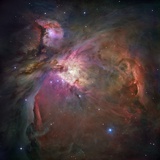
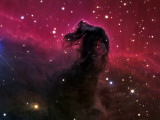
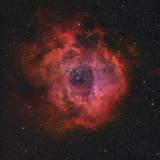
In astronomy the term nebula, root meaning “cloud”, many times refers to space phenomenon more complicated than a simple cloud - galaxies, globular and open clusters, emission nebulae, reflection nebulae, dark nebulae, planetary nebulae and supernove remnants.
|
|
|
|
|
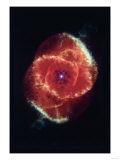
Cat's Eye Nebula (NGC 6543, Caldwell 6) is a planetary nebula in the constellation of Draco.
Around 1000 years ago the bright, hot star at the center of the Cat's Eye lost its outer envelope, producing the nebula.
Cat's Eye is one of the most complex nebulae known with structures such as knots, jets, bubbles and arc-like features.
|
|
|
|
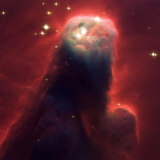
The Cone Nebula, NGC 2264, is located in the H II region in the constellation of Monoceros. The nebula is part of a much larger star-forming complex included in the Christmas Tree Cluster
It was discovered by William Herschel on December 26, 1785.
The Cone Nebula forms part of the nebulosity surrounding the Christmas Tree Cluster. The designation of NGC 2264 in the New General Catalogue refers to both objects and not the nebula alone.
• Hubble posters
|
|
|
|
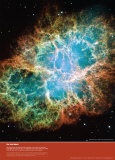
Crab Nebula is the aftermath of the explosion of an ancient star more than 6,500 light-years away. The star's core still pulses at the center of the nebula, while the other colors are particles and gases released in the explosion.
|
|
|
|
|
|
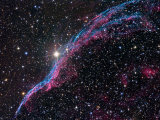
| The Cygnus Loop, radio source W78, or Sharpless 103, is a large supernova remnant (SNR) in the constellation Cygnus. Some arcs of the loop, known collectively as the Veil Nebula, NGC 6960, or Cirrus Nebula, emit in visible light. |
|
|
|
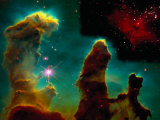
Its shape resembles an eagle, the Eagle Nebula, aka Messier 16 or M16, and NGC 6611, is a young open cluster of stars in the constellation Serpens, discovered by Jean-Philippe de Cheseaux in 1745-46.
It is the subject of the famous “Pillars of Creation” photograph by the Hubble Space Telescope, which shows pillars of star-forming gas and dust within the nebula.
|
|
|
|
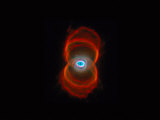
Hourglass Nebula, aka MyCn 18, is a young planetary nebula in the southern constellation Musca, about 8,000 light-years away from Earth.
It was discovered by Annie Jump Cannon and Margaret W. Mayall during their work on the Henry Draper Catalogue Extension (HDE).
|
|
|
|
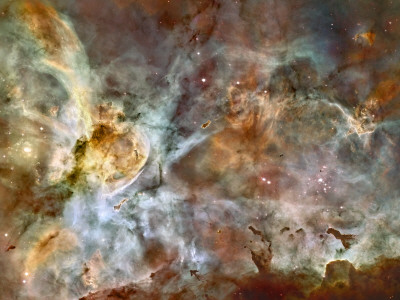
The Keyhole Nebula was discovered in the 19th century, it contains swirling clouds of gas, dust and ... molecules, as well as some of the largest and hottest stars ever recorded. The Keyhole Nebula is loacated inside NGC 3372, the massive Carina Nebula.
|
|
|
|
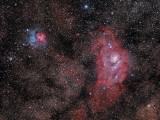
The Lagoon Nebula, Messier 8, M8, and NGC 6523, is a giant interstellar cloud in the constellation Sagittarius some 4,000 - 6,000 light years away from Earth.
The Lagoon Nebula was discovered by Guillaume Le Gentil in 1747 and is one of only two star-forming nebulae faintly visible to the naked eye from mid-northern latitudes.
|
|
|
|
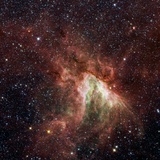
Omega Nebula, also known as the Checkmark Nebula, Lobster Nebula, and the Horseshoe Nebula, catalogued as Messier 17, M17, and NGC 6618, is a glowing cloud of gas and dust located some 5500 light years away toward the constellation Sagittarius.
It was discovered by Philippe Loys de Chéseaux in 1745 and Charles Messier catalogued it in 1764.
|
|
|
|
|
|
|
|
|
|
|
|
|
The Tarantula Nebula, aka 30 Doradus, or NGC 2070, is an H II region in the Large Magellanic Cloud (LMC).
In 1751 Nicolas Louis de Lacaille recognized the nebular nature of what was originally thought to be a star. The closest supernova observed since the invention of the telescope, Supernova 1987A, occurred at the edge of the Tarantula Nebula.
|
|
|
|
Harlow Shapley
b. 11-2-1885; Nashville, MO
d. 10-20-1972
Harlow Shapley was one of the first astronomers to realize the Milky Way Galaxy was larger than previously thought and the Earth's Sun was in a “nondescript” area of the galaxy. He was one of the participants in the “Great Debate” of 1920 on the nature of nebulas.
Shapley had dropped out of school with a 5th grade education, but studied at home and went back to high school to become the class valedictorian. He then went to the University of Missouri, ending up with an astronomy degree. Eventually he became head of Harvard University Observatory and was also a victim of McCarthyism.
|
|
|
previous page | top
|
|
I have searched the web for visual, text, and manipulative curriculum support materials - teaching posters, art prints, maps, charts, calendars, books and educational toys featuring famous people, places and events - to help teachers optimize their valuable time and budget.
Browsing the subject areas at NetPosterWorks.com is a learning experience where educators can plan context rich environments while comparing prices, special discounts, framing options and shipping from educational resources.
Thank you for starting your search for inspirational, motivational, and educational posters and learning materials at NetPosterWorks.com. If you need help please contact us.
|
|
|