|
|
Langston Hughes Educational Posters, Books, Videos, Links for Learning
|
literature > authors list > LANGSTON HUGHES < famous men < black history <social studies
|
|
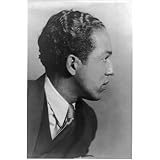
Langston Hughes
b. 2-1-1902; Joplin, Missouri
d. 5-22-1967; NY
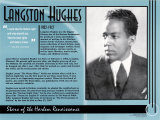
James Langston Hughes, known as the Poet Laureate of the Harlem Renaissance, was born in Joplin, Missouri to Carrie Langston Hughes and James Hughes. His parents separated when he was very young; his father moved to Mexico and his mother lived wherever she could find work. With his parents absent, Langston was raised by his maternal grandmother Mary Langston in Lawrence, Kansas.
It is interesting to note that Hughes came from an abolitionist family tradition. His grandmother’s first husband was killed at Harper’s Ferry as a member of John Brown’s group (Brown lived in Osawatamie, KS, close to Lawrence) and a brother of his grandfather was the first black elected to a public office.
As an adolescent Langston Hughes lived several places after he was able to rejoin his mother and new stepfather. They finally settling in Ohio where he graduated from Cleveland’s Central High School in 1920.
Langston Hughes began writing poetry at a young age. It was on one of his trips to visit his father in Mexico that he wrote a poem called “The Negro Speaks of Rivers” that first drew widespread attention to his talent.
His father helped him attend Columbia University in New York with the stipulation he study a profession that would pay better than being a writer. But his poetry kept calling him and he left in 1922 without graduating. He did finish college at Lincoln University in Pennsylvania in 1929. The time between colleges was spent travelling abroad and working at menial jobs such as on a freighter of the coast of West Africa and living in Paris.
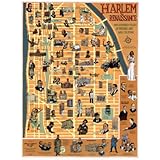
During the 1920s Harlem was a magnet for the creative artists, writers and musicians that were part of the northward and urban migrations of African Americans. What became known as the Harlem Renaissance was a literary movement and social revolt against racism, and a celebration of the unique African American culture through words, music and dance. Hughes was also a founder of the Negro Playwrights' Company with Theodore Ward, Richard Wright and Paul Robeson, among others.
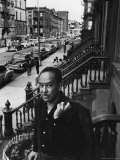
Langston Hughes died of complications from prostate cancer. East 127th Street was renamed “Langston Hughes Place” and his home was been given landmark status by the New York City Preservation Commission.
|
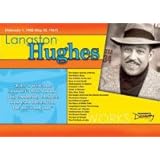
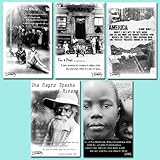
Comprehensive selection of African American poet and author Langston Hughes educational posters plus short biography, recommended reading, links for learning.
|
|
|
|
|
Langston Hughes
“The night is beautiful,
So the faces of my people,
The stars are beautiful,
So the eyes of my people,
Beautiful also is the sun,
Beautiful also are the souls of my people.”
My People
• more 20th Century Authors
|
|
|
|
|
|
|
|
|
|
|
|
|
|
|
|
|
|
|
|
|
|
|
|
|
|
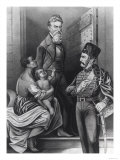
John Brown (1800-59), the Martyr, Pub. by Currier & Ives, 1870, Giclee Print
|
|
|
|
|
• Poetry Forms posters
|
|
|
• “What happens to a dream deferred? Does it dry up Like a raisin in the sun? . . . Or does it explode?”
• “Reach up your hand... and take a star.”
Books about Langston Hughes...
The Big Sea: An Autobiography (American Century) by Langston Hughes - recounts the memorable years of the 1920s in Harlem and in Paris where he worked as a cook and a waiter in nightclubs.
The Life of Langston Hughes by Arnold Rampersad
Langston Hughes Reads His Poetry - audio cassette - Langston Hughes shares the life experiences that set him on the path to become one of America’s greatest poets. Interspersed between his vibrant, masterful works, Hughes describes the sights, sounds, and memories of mid-century America, illuminating many events he experienced growing up black in an openly segregated and prejudiced society.
The Ways of White Folks - in these acrid and poignant stories, Hughes depicted black people colliding-sometimes humorously, more often tragically-with whites in the 1920s and ’30s.
Langston Hughes: Young Black Poet (Childhood of Famous Americans) - a comprehensive account of the great Black personalities in world history.
And Poetry...
Rose, Where Did You Get That Red? Teaching Great Poetry to Children by Kenneth Koch - Teachers of poetry from elementary to high school will enjoy teaching poetry with this method or incorporating the ideas into existing curriculum.
Africans in America: America’s Journey Through Slavery (1998 VHS) - groundbreaking six hour series of surprising revelations, dramatic recreations, rare archival photography and riveting first-person accounts. Africans in America helps define the reality of slavery’s past through the insightful commentary of a wide range of voices, including General Colin Powell and leading scholars, and offers unparalleled understanding - from slavery’s birth in the early 1600s through the violent onset of civil war in 1860. Narrated by Angela Bassett; includes the voices of William Hurt and Andre Braugher. Winner 1998 Peabody Award.
LINKS FOR LEARNING : LANGSTON HUGHES
|
previous page | top
|
|
I have searched the web for visual, text, and manipulative curriculum support materials - teaching posters, art prints, maps, charts, calendars, books and educational toys featuring famous people, places and events - to help teachers optimize their valuable time and budget.
Browsing the subject areas at NetPosterWorks.com is a learning experience where educators can plan context rich environments while comparing prices, special discounts, framing options and shipping from educational resources.
Thank you for starting your search for inspirational, motivational, and educational posters and learning materials at NetPosterWorks.com. If you need help please contact us.
|
|
|