|
|
Rosa Parks Posters, Books, Video, Links for Learning
for social studies, black history studies, and home schoolers.
|
social studies > black history > ROSA PARKS < activists < notable women
|
|
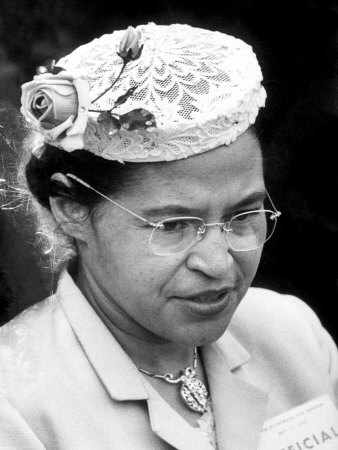
Rosa Parks
b. 2-4-1913; Tuskegee, Alabama
d. 10-24-2005; Detroit, MI
Rosa Louise McCauley Parks, the “Mother of the Modern Civil Rights Movement”, was the daughter of James and Leona McCauley. She grew up on a small farm with her mother, brother and grandparents.
Rosa attended a one room school for African American children that went up to the 6th grade and met only five months a year. When she was eleven Rosa went off to Montgomery to continue school but had to return home when she was 16 to help care for her grandmother, and then her mother.
In 1932 Rosa married Raymond Parks and with his help she continued her education, graduating from high school in 1934. Raymond was a barber and Rosa a seamtress, they both worked for the NAACP chapter in Montgomery. In 1943 Rosa was appointed secretary of the branch and later its youth leader.
On December 1, 1955 Rosa refused to give up her seat on the bus to a white person and was arrested. Rosa was not the first person arrested for failing to giving up their seat, but she was the best known because of her work with the local NAACP. When the black community found out about the arrest, the young minister at the Dexter Avenue Baptist Church, Dr. Martin Luther King, Jr. called a meeting where a boycott of the bus system was called. Her action of not giving up her seat to a white passenger sparked the 381-day Montgomery, Alabama bus boycott, and, eventually the Supreme Court’s ruling in November 1956 that segregation on transportation is unconstitutional.
Rosa Parks received the NAACP Spingarn Medal for outstanding acievement by an African-American in 1979 and awarded the Medal of Freedom, presented by President Clinton in 1996.
Mrs. Parks was the first woman to lie in state in the U.S. Capitol Rotunda.
|
|
|
|
|
|
Timeline-
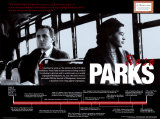
Rosa Parks Poster
Poster Text: “I would like to be known as a person who is concerned about freedom and equality and justice and prosperity for all people.” Described by some as “the mother of the civil rights movement,” Rosa Parks is best known for being arrested for refusing to give her seat to a white man on a racially segregated Montgomery, AL., bus. Her action led to a successful 380-day boycott of Montgomery buses and a Supreme Court ruling against segregation.
• more Timeline posters
|
|
|
|
|
|
Famous Americans, Rosa Parks - Black History 2 Poster
“People always say that I didn't give up my seat becasue I was tired, but that isn't true. I was not tired physially, or no more tired than I usually was at the end of a working day. I was not ole, although some people have an image of me being old then. I was forty-two.”
Rosa Parks was an African American civil rights activist who the US Congress later called “Mother of the Modern Day Civil Rights Movement”.
On December 1, 1955, Parks became famous for refusing to obey bus driver James Blake's order that she give up her seat to make room for a white passenger.
This action of civil disobedience started the Montgomery Bus Boycott, which is one of the largest movements against racial segregation.
|
|
|
|
|
|
|
|
|
|
Montgomery Honor Roll
Sparked by the December 1, 1955 arrest of Rosa Parks for refusing to give up her seat on a bus, black citizens of Montgomery Alabama, boycotted the city buses from December 5 of that year until December 20, 1956. During that period many boycott organizers and participants were arrested, some of whom are shown ere. The boycott ended when a United States supreme Court ruling declared that segregation on buses was illegal.
“I submit that an individual who breaks a law that conscience tells him is unjust, and willingly accepts the penalty by staying in jail to arouse the conscience of the community over its injustice, is in reality expressing the highest respect for law.” ~ Martin Luther King, Jr.
|
|
|
|
|
|
Crossroads of Dreams
Rosa Parks quotes:
“The only tired I was, was tired of giving in.”
“My only concern was to get home after a hard day's work.”
“Each person must live their life as a model for others.”
“Memories of our lives, of our work and our deeds will continue in others.”
Martin Luther King, Jr. quotes:
“Injustice anywhere is a threat to justice everywhere.”
“Freedom is never voluntarily given by the oppressor; it must be demanded by the oppressed.”
“A right delayed is a right denied.”
“I have a dream that my our little children will one day live in a nation where they will not be judged by the color of their skin, but by the content of their character.”
• more quotes and quotes posters
|
|
|
|
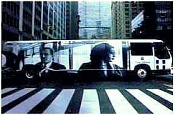
Rosa Parks, Think Different poster
|
Rosa Parks,
Think Different Poster
|
|
|
|
|
|
The Woman I Am
The links of courage
made a chain
that cannot be broken...
The hands that made
each golden link
left me a pricelss token.
My heritage has been the shield
that kept me strong and free...
The woman that I am today
now walks victoriously.
|
|
|
|
|
|

Rosa Parks,
Great American Women Poster
no longer available
|
Great Black Americans -
Rosa Parks Poster
Poster Text: Years ago, a young black girl named Rosa McCauley was walking down a street in Montgomery, Alabama. As she passed a white boy on roller skates, the boy gave her a shove. Rosa pushed him back. The boy's mother looked at her angrily and threatened to have Rosa put in jail for pushing her son. Rosa responded that the boy had pushed her, and since she hadn't bothered him, she didn't want to be pushed. Years later, the whole world would discover that Rosa Parks was not someone who could be pushed around.
Rosa McCauly was born in Tuskegee, Alabama, in 1913. Her father was a carpenter and builder, and her mother was a teacher. When Rosa was still very young, she moved with her mother to her grandparent's small farm in Pine Level, Alabama. When she was eleven, Rosa left home to go to school in Montgomery because there were no black junior high schools in her area. Rosa had to leave school in eleventh grade so she could care for her mother and grandmother. Growing up in the South, Rosa lived under segregation – a system that separated blacks and whites and treated blacks as though they were inferior. African-Americans had to go to separate schools, eat in separate restaurants, even drink from separate water fountains. But from an early age, Rosa was taught to be proud of herself and of other black people. In 1932, she married a barber named Raymond Parks. The next year, she got her high school diploma. In 1943, Mrs. Parks joined the local chapter of the National Association for the Advancement of Colored People, or NAACP. In her own quiet way, she began to work for changes in the way blacks were treated in America.
On December 1, 1955, Mrs. Parks left her job as a seamstress and boarded a bus for the long ride home. She walked toward the rear of the bus to find a seat – just as blacks were required to do. The seats up fron were reserved for whites. Soon the bus began to fill up, and suddenly the bus driver was standing over Mrs. Parks ordering her to get up so a white man could have her seat. Mrs. Parks thought for a moment and then said, “No.” The next thing she knew, she was on her way to the police station. Soon the whole city – and then the entire nation – had heard about the brave woman who refused to give up her seat. Rosa Parks became a hero to many African Americans, who decided that it this quiet woman could stand up to prejudice, so could they. In many ways, Rosa Parks's simple act of protest started the whole civil rights movement, which would eventually help African Americans gain many rights. For this reason, she is known today as “The Mother of the Civil Rights Movement.”
• more Great Black Americans posters
|
|
|
|
|
• more Civil Rights posters
• more famous women posters
|
|
|
“Memories of our lives, of our works and our deeds will continue in others.”
Rosa Parks
ROSA PARKS BOOKS, VIDEO
Rosa Parks, My Story by Rosa Parks - straightforward, compelling autobiography, Rosa Parks talks candidly about the civil rights movement and her active role in it.
I Am Rosa Parks (Puffin Easy Read) - ages 4-8 .The black woman whose acts of civil disobedience led to the 1956 Supreme Court order to desegregate buses in Montgomery, Alabama, explains what she did and why.
Eyes on the Prize video - One of the essential documentary series from 20th-century television, Eyes on the Prize is an extraordinary, grassroots history of the civil rights movement in 1950s and ’60s America. Leaving punditry and debate to others, this six-hour program concerns itself with the individuals who were there, who participated on the front lines, who witnessed and survived to tell about the crusade's tragedies and victories. Starting with a pair of mid-'50s heroic actions in the South that helped galvanize black and white activism against institutional racism (actions that included Rosa Parks’s refusal to give up her bus seat to a white passenger in Montgomery, Alabama), the series winds its way through the exponential growth of the movement to the passage of the Voting Rights Act and beyond. The epochal battle between states-rights advocates and federal authorities is well-covered, as are the many sacrifices made and enormous risks taken by Mississippi Freedom Riders and advocates of black voter registration. Also in this boxed set is the series’ sequel, Eyes on the Prize II: America at the Racial Crossroads 1965-mid 1980s. An equally stirring, eight-hour history of the post-civil-rights years, in which hard-won political power manifested itself both inside and outside elected government offices, this follow-up traces the fracturing of a unified civil rights community into numerous missions and agendas. Driven by interviews and archival footage, the series takes a clear look at such historical chapters as the rise of black separatism, the election of Carl Stokes to Cleveland’s Office of the Mayor, and the turmoil of school desegregation. Both the original series and sequel are an absolute must for a contemporary understanding of racism in America.
The Long Haul: An Autobiography by Myles Horton -Primarily a treatise on the beliefs which governed Horton's life, rather than a traditional autobiography, the book describes Horton's life from a Depression-era Tennessee family to the founding of the Highlander Folk School to a world-renowned position in the field of community education. Rosa Parks, Martin Luther King, Jr., Ralph Abernathy, Pete Seeger, Woody Guthrie, Saul Alinsky, and Eleanor Roosevelt gained inspiration at Highlander.
LINKS FOR LEARNING: ROSA PARKS
|
previous page | top
|
|
I have searched the web for visual, text, and manipulative curriculum support materials - teaching posters, art prints, maps, charts, calendars, books and educational toys featuring famous people, places and events - to help teachers optimize their valuable time and budget.
Browsing the subject areas at NetPosterWorks.com is a learning experience where educators can plan context rich environments while comparing prices, special discounts, framing options and shipping from educational resources.
Thank you for starting your search for inspirational, motivational, and educational posters and learning materials at NetPosterWorks.com. If you need help please contact us.
|
|
|
|