|
|
Abraham Lincoln, Emancipation Proclamation and Gettysburg Address Posters and Prints (pg 3/6)
for the social studies and language arts classrooms, home schoolers.
|
social studies > famous men > Abraham Lincoln 1 | 2 | 3 | 4 | 5 | 6 | Lincoln Quotes | Lincoln Autobiographies < Lincoln Books & Links
|
|
Emancipation Proclamation, the Gettysburg Address, and U. S. President Abraham Lincoln educational posters and prints for the social studies and language arts classrooms, home schoolers and as theme decor for Lincoln and Civil War scholars.
|
|
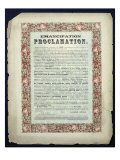
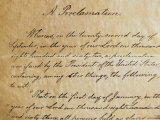
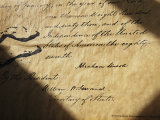
Emancipation Proclamation, 1862
Lincoln signed the Emanicipation Proclamation with the goal of weakening the rebellion of the southern states, which were led and controlled by slave owners. Lincoln insisted that only the outbreak of war gave constitutional power to the President to free slaves in states where it already existed. On its first day, January 1, 1863, the Emancipation Proclamation freed only a few escaped slaves, but as northern Union armies advanced south, more and more slaves were liberated until hundreds of thousands were freed. Lincoln later said: “I never, in my life, felt more certain that I was doing right, than I do in signing this paper.”
|
|
|
|
The Emancipation Proclamation
“I do order and declare that all persons held as slaves within designated States, and parts of States, are, and henceforward shall be free.”
In the middle of the Civil War, President Abraham Lincoln signed the Emancipation Proclamation, declaring that all the slaves in the territories that were fighting against the Union “are, and henceforward shall be free.” With this document, President Lincoln made it clear that the purpose of the Civil War was not only to preserve the Union, it was also to free the slaves.
Although Lincoln had always opposed slavery, the Civil War was not, in the beginning a fight to end it. Southern states had seceded, or separated, from the United States because they were worried that the U. S. governemnt would try to limit slavery. Lincoln's primary goal was to hold the country together. He worried that if he tried to end slavery, slave states such as Kentucky and Missouri, which bordered the South but remained part of the Union, would join the Confederacy. But eventually, Lincoln realized that the United States could not survive if some of its people were not free. In addition, he needed to gain the support of countries such as France and England. These countries relied on the South to supply them with cotton, but they were also very opposed to slavery, if the Union's aim was to free the slaves, they would side with the North.
On January 1, 1864, Lincoln issued the Emancipation Proclamation. In it, he said freeing the slaves was ‘an act of justice.’ But though the proclamation sent an important message against slavery, it did not free a single slave on the day it was signed. The proclamation only freed slaves in the states that were not under the control of the Union. Slaves in the loyal border states were not freed, and Lincoln had no authority to free the slaves in areas controlled by the Confederacy. But as the Union army advanced and took control of new Confederate territories, slaves were freed. The proclamation also welcomed African Americans into the Union's armed forces. By the end of the war nearly 200,000 former slaves and free black had fought for the Union.
Abraham Lincoln later said that the Emancipation Proclamation was “the central act of my administration, and the greatest event of the 19th century.” Although it was mostly symbolic on the day it was signed, the proclamation sent a message that the United States was a free nation where slavery would not be tolerated. Henry Ward Beecher, a leading abolitionist, affirmed “The Proclamation may not free a single slave, but it gives Liberty a moral recognition.” The work that began with the Emancipation Proclamation was completed on December 18, 1863, with the ratification of the 13th Amendment ot the Constitution, banning slavery in the United States.
• Civil Rights posters
|
|
|
|
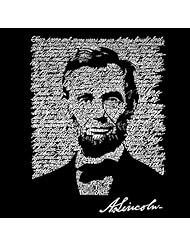
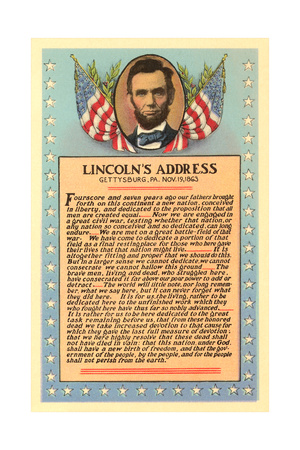
Lincoln with Text of Gettysburg Address
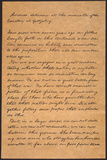
Lincoln Gettysburg Address
November 19, 1863; Gettysburg, PA
The Gettysburg Address was delivered at the dedication of the Soldiers' National Cemetery in Gettysburg, Pennsylvania, on November 19, 1863, during the American Civil War, four and a half months after the Battle of Gettysburg. The Gettysburg Address is the most famous speech of President Abraham Lincoln and one of the most quoted speeches in United States history.
• more Civil War posters
• more Historic Documents posters
|
|
|
|
|
|
|
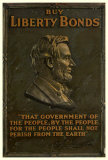
Buy Liberty Bonds
“That government of the people, by the people, for the people shall not perish from the Earth.” Abraham Lincoln
Liberty Bonds were a type of savings bonds as a way to support the US World War I effort. In the Second World War they were called Defense Bonds.
|
|
|
|
I have searched the web for visual, text, and manipulative curriculum support materials - teaching posters, art prints, maps, charts, calendars, books and educational toys featuring famous people, places and events - to help teachers optimize their valuable time and budget.
Browsing the subject areas at NetPosterWorks.com is a learning experience where educators can plan context rich environments while comparing prices, special discounts, framing options and shipping from educational resources.
Thank you for starting your search for inspirational, motivational, and educational posters and learning materials at NetPosterWorks.com. If you need help please contact us.
|
|
|