|
|
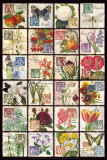
Botany Educational Posters, Prints & Charts
- illustrations for the science classroom and gardeners
|
science > biology > biomes > BOTANY POSTERS | botantists < food < social studies
|
|
Botany is plant biology, the scientific study of the growth, reproduction, metabolism, development, diseases, ecology, and evolution of plants. Plants are the foundation most “food chains” and botany has applications in agriculture, forestry, gardening, herbology, and medicine.
Botantists, scientists who study plants, will
- classify plants (taxonomy),
- observe the structure (anatomy),
- and function (physiology) of plants.
Plants are organisms such as trees, flowers, herbs, bushes, grasses, vines, ferns, and mosses. Organisms like some algae and fungi have been moved from the Kingdom Plantae to Kingdom Protista in modern taxonomy.
Botany Quotes ~
• “Bring diversity back to agriculture. That's what made it work in the first place.” ~ David Brower
• “Environmental scientists have been saying for some time that the global economy is being slowly undermined by environmental trends of human origin, including shrinking forests, expanding deserts, falling water tables, eroding soils, collapsing fisheries, rising temperatures, melting ice, rising seas and increasingly destructive storms.” ~ Lester R. Brown
• “Life has always seemed to me like a plant that lives on its rhizome. Its true life is invisible, hidden in the rhizome. The part that appears above ground lasts only a single summer. What we see is the blossom, which passes. The rhizome remains.” ~ Carl Gustav Jung
• “The naturalist is a civilized hunter. He goes alone into the field or woodland and closes his mind to everything but that time and place, so that life around him presses in on all the senses and small details grow in significance. He begins the scanning search for which cognition was engineered. His mind becomes unfocused, it focuses on everything, no longer directed toward any ordinary task or social pleasantry.” ~ E. O. Wilson, Biophilia
|
|
|
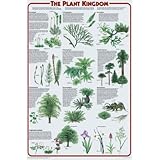
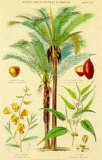
Plant Kingdom Poster offers comprehensive view of plants prepared by botantical illustrator, images of representational species, including extinct species. An excellent companion to the Animal Kingdom Poster.
|
|
|
|
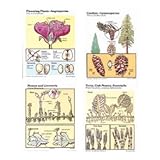
4 reproducible activity sheets,
a teacher's guide, and
4 sturdy 17" x 22" posters:
- Conifers-Gymnosperms,
- Ferns/Club Mosses/Horsetails,
- Flowering Plants-Angiosperms, and
- Mosses/Liverworts.
|
|
|
|
|
|
|
|
|
|
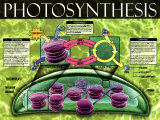
Photosynthesis
Nearly all life depends on the biochemical process photosynthesis (photo = light, synthesis = putting together), is the production of glucose from the combination of sunlight, carbon dioxide and water, with oxygen as a waste product.
• more biology posters
|
|
|
|
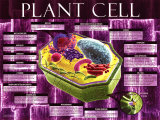
Plant Cell Poster
The word cell, from “cella” the Latin for small room, was adopted by English scientist Robert Hooke to describe what he saw through a microscope.
• more cell posters
|
|
|
|
Phytoplanktons (Gr. phyto=plant + planktos=wanderer) are literally plants drifting in water, both salt and fresh. Phytoplankton account for 50% of the photosynthesis activity on Earth, are therefore responsible for 50% of the oxygen produced by all plant life.
It is reported that phytoplankton has declined by approximately 40% since 1950, possibly due to climate change and the resulting warming ocean temperature.
Phytoplanktons are an critical component in the global food chain.
FYI- look at the word planktos - it is related to the word planet.
|
|
|
|
|
|
|
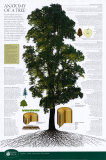
Anatomy of a Tree
The extraordinary solar-powered machines called trees perform a function that is essential for nearly all life on Earth. They create most of the oxygen we breathe, while also absorbing toxins that would otherwise enter the atmosphere. Providing habitat for innumerable creatures, trees are a vital like in many different ecosystems, from tropical rainforests to the temperate forest of the north. Whether in our backyards or in the world's remaining wild places, the health and proliferation of trees are essential to sustaining a living planet. ... PHOTOSYNTHESIS, CONIFER V. BROADLEAF, SECTIONS OF A TREE
• more trees & forest posters
• more anatomy posters
|
|
|
|
Indian Corn of the Americas
The precursor plant to what we know as corn today is believed to be a wild grass called teosinte, indiginous to central Mexico, and first cultivated (made part of the culture) about 7,000 years ago. The wild grass, which has relatively few, small seeds that easily scatter when the plant is touched, was domesticated for traits of larger, easier to harvest seeds. The domesticated plant and seeds came to be known as maize by the indiginous peoples throughout North and South America, and a major food source. Europeans were unaware of corn before the explorations of Christopher Columbus.
• more Native Americans posters
• King Corn DVD
|
|
|
|
|
|
|
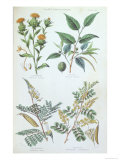
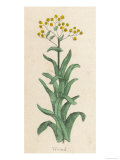
Dyeing, giving color to fibers and food, has an over 5,000 year history. A few plants providing colors are safflower, brazilwood, logwood, and fustic. Woad gives a blue dye.
|
|
|
|
|
|
|
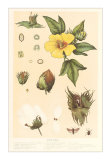
Plants used in textiles include grass, rush, hemp, and sisal (rope); coconut fiber (twine, floormats, brushs, sacking); straw and bamboo (hats); and cotton, flax, jute (clothing).
The Industrial Revolution demanded more and more cotton in the production of textiles, which in turn fueled the demand slaves to cultivate the cotton in the Southern US.
• Eli Whitney
|
|
|
|
|
|
|
|
|
|
|
|
previous page | top
|
|
I have searched the web for visual, text, and manipulative curriculum support materials - teaching posters, art prints, maps, charts, calendars, books and educational toys featuring famous people, places and events - to help teachers optimize their valuable time and budget.
Browsing the subject areas at NetPosterWorks.com is a learning experience where educators can plan context rich environments while comparing prices, special discounts, framing options and shipping from educational resources.
Thank you for starting your search for inspirational, motivational, and educational posters and learning materials at NetPosterWorks.com. If you need help please contact us.
|
|
|