NetPosterWorks - Educational Posters selected for teachers by a teacher.


EDUCATIONAL, REFERENCE, &
CLASSROOM POSTERS INDEX -
art education & history
dance
early childhood
food & cuisine
geography
health & fitness
history
holidays
language arts & literature
math
motivational
music
notable people
peace education
pets & animals
theology
science
social studies
vocational education
Global PathMarkers
Free Poster Index
History of Posters


FAQS/ABOUT
SEARCH
CONTACT
LINKS FOR LEARNING
LESSON PLAN IDEAS
BOOKSHELVES
ECARDS


DESERTS
CALENDARS
Desert Life Calendar 2009
Desert Life
Calendar 2009

Desert Southwest Calendar 2009

Desert in Bloom Calendar 2009

Saguaros Calendar 2009
Saguaros
Calendar 2009

Desert Critters Pocket Planner 2009
Desert Critters
Pocket Planner 2009

Silk Road, Calendar 2009
Silk Road,
Calendar 2009


Under Water muralAquatic Wall Murals


Teacher's Best - The Creative Process


Deserts of the World Posters, Prints, Charts
for environmental, ecology, and geography educators & classrooms, travelers.

educational posters > geography > landforms > deserts < social studies


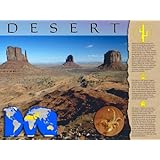
Desert Biome Poster
Desert Biome Poster

• more biome posters

A desert, with its very dry environment with extreme temperatures, has limited animal and plant life. The biggest desert: Sahara (Africa); driest: Atacama (Chile) and Lut (Iran); coldest: Gobi (Asia) and the desert on the Antarctica continent.

DESERTS
Antarctic
Arabian
Atacama
Chihuahuan
Gobi
Great Basin
Kalahari
Libyan
Mojave
Namib
Negev
Nubian
Patagonia
Rangipo
Sahara
Sonoran
Taklamakan
Tenere

Poster Text: Deserts are harsh environments found all around the world, covering about one-fifth of the planet. Characterized by low rainfall, deserts receive less than 25 centimeters of rain per year. While most are swelteringly hot, such as the Australian Desert, a few, like the Gobi Desert in Asia can get very cold. Desert temperatures might also drop at night, and can plunge below freezing during the winter season. Despite the lack of water and other extreme conditions, most deserts are home to many species of plants and animals.
Life native to the desert is highly specialized and well-adapted to the extreme climate. Sagebrush, short grasses, creosote bushes and cacti are just a few of the plants found there. Desert plants have root and water storage systems ideal for minimizing moisture loss. Within hours of rainfall, desert plants bloom, reproduce, and store water needed for the coming drought.
The desert is home to many reptiles, insects, birds and some small mammals, such as the kangaroo mice in North America. The animals surviving in the desert have evolved perfectly to suit the climate. Most desert animals are nocturnal, sheltering themselves from the sun during the day, either in shade or burrows. A unique physical adaptation is the storage of fat in humps or tails, rather than throughout the body, as fat causes heat to intensify. The absence of sweat glands, and the concentration of urine are other physical adaptations.


An Aerial View of an Irrigation Project in the Saudi Arabian Desert, Photographic Print
Bones, Relic of
Whaling Industry,
Port Lockroy,
Antarctic Peninsula,
Photographic Print

Antartica is technically the largest desert in the world even though about 70% of the world's fresh water is locked up there as ice.

• more Antarctic posters

LANDFORMS

bays, gulfs, headlands
biomes
continents
deserts
islands
lakes
mesa, plateau, butte
monolith
mountains
oceans & seas
river & stream


DESERT
BOOKS
Deserts of the Earth
Deserts of
the Earth

Deserts
Deserts


Desert Queen: The Extraordinary Life of Gertrude Bell: Adventurer, Adviser to Kings, Ally of Lawrence of Arabia
Desert Queen:
The Extraordinary Life
of Gertrude Bell


An Aerial View of an Irrigation Project in the Saudi Arabian Desert, Photographic Print
An Aerial View of an Irrigation Project in the Saudi Arabian Desert,
Photographic Print

Arabian Desert occupies most of the Arabian Peninsula (900,000 square miles or 2,330,000 square kilometers) and the Kingdom of Saudi Arabia; it also includes Yemen, Oman, Jordan and Iraq.

The Rub'al-Khali, one of the largest continuous bodies of sand in the world, covers the southern third of the penisula, is also one of the most oil rich regions of the world.


El Tatio Geyser, Atacama, Chile, South America, Photographic Print
El Tatio Geyser, Atacama, Chile, South America,
Photographic Print

Atacama Desert in Chile, the driest desert in the world, gets a double "rain shadow" effect from the high pressure over the Pacific to the west and Andes Mountains to the east.

The Atacama has the world's largest deposit of natural sodium nitrate, "saltpeter", that had been mined significantly until the a synthetic nitrate was invented. Now, because of the high elevation, cloud free sky, and low population (no radio interference) several astronomical observatories are located in the Acatcama. Also the North-South Pan American Highway runs through the Atacama.


Bardenas Reales National Park, Navarre, Spain, Photographic Print
Bardenas Reales National Park,
Navarre, Spain,
Photographic Print

Bardenas Reales in Navarre, Spain


Chihuahuan Desert, Mexico, Photographic Print
Chihuahuan Desert, Mexico, North America
Photographic Print

The vast Chihuahuan Desert stretches from a small area of southeastern New Mexico and extreme western Texas into a vast area of Mexico.


The Hongorin Els Dunes in the Gobi Desert, Photographic Print
Hongorin Els Dunes
Gobi Desert, China
Photographic Print

The Gobi, the largest desert in Asia, and 4th largest in the world, covers parts of China and southern Mongolia. The lack of precipitation that created the Gobi is caused by the "rain shadow" effect of the Himalaya Mountains.

Ray Chapman Andrews lead an expedition into the Gobi in which palentologist Teilhard de Chardin participated.


Antelope Island and Mud Flats, Great Salt Lake, Great Basin, Utah, USA, Photographic Print

The Great Basin Desert is contained within the Great Basin watershed area of the western United States between the Wasatch Mountains and the Sierra Nevada. While exact boundaries defy establishment, the Great Basin Desert covers much of northern Nevada, western and southern Utah, the southern third of Idaho, the southeastern corner of Oregon, and melds into Colorado and Wyoming. The Mojave Desert is within the watershed of the Great Basin, as is the Great Salt Lake.


View Towards Barren Interior, North-East Iceland, Photographic Print
View Towards Barren Interior, North-East Iceland,
Photographic Print

Highlands of Iceland, Hálendi, Desert


Salt Pans Deep in the Kalahari with 4X4 Tracks and Animal Tracks, South Africa, Photographic Print
Kalahari Salt Pans
with 4X4 and
Animal Tracks,
South Africa,
Photographic Print

The Kalahari Desert is not a true desert. It is an arid to semi-arid sandy area of 362,500 sq. mi. (900,000 km), consisting of much of Botswana and parts of Namibia and South Africa; the surrounding Kalahari Basin extends further into neighboring Angola, Zambia and Zimbabwe. The Okavango River flows into a wildlife rich delta and after good rains the Kalahara has huge areas of excellent grazing. The 1980s movie, The Gods Must Be Angry was about a native Bushman's encounter with the western world.


An Aerial View of an Irrigation Project in the Saudi Arabian Desert, Photographic Print
An Aerial View of an Irrigation Project in the Saudi Arabian Desert,
Photographic Print

Libyan Desert


Rare Winter Snowfall, Lost Horse Valley, Joshua Tree National Park, California, USA, Photographic Print
Rare Winter Snowfall,
Lost Horse Valley,
Joshua Tree Nat'l Park,
California, USA,
Photographic Print

The Mojave Desert covers portions of California, Utah, Nevada, and Arizona. Named for the Mohave Indians (both spellings are correct), the boundaries of the Mohave are indicated by the presence of Joshua trees (Yucca brevifolia), whose uplifted branches reminded the Mormon pioneers of the biblical figure Joshua. Death Valley, the lowest & hottest place in North America is in the Mohave, as is Las Vegas, NV. Some do not consider the Mojave a separate desert but a transition between the Great Basin Desert the the north is and to the south and east is the Sonoran Desert.


An Aerial View of an Irrigation Project in the Saudi Arabian Desert, Photographic Print
Sunset over the Blistering Namib, The World's Oldest Desert, Photographic Print

Namib Desert


Negev Desert, Photographic Print

Negev Desert - Israel


An Aerial View of an Irrigation Project in the Saudi Arabian Desert, Photographic Print
An Aerial View of an Irrigation Project in the Saudi Arabian Desert,
Photographic Print

Nubian Desert


Andes Mountain Range, Near El Calafate, Patagonia, Argentina, South America, Photographic Print
Patagoia Desert with Andes Mountain Range, Near El Calafate, Argentina, South America, Photographic Print

Patagonia, the largest desert in the Americas and the 5th largest in the world (260,000 sq mi / 673,000 km), is also known as the Patagonian Steppe. A cold winter desert in the rain shadow of the Andes Mountains, Patagonia is located primarily in Argentina, with small parts in Chile. The name seems to come from the European explorers (average height 5'1" tall) who experienced the natives average height of 5'11", as giants.


An Aerial View of an Irrigation Project in the Saudi Arabian Desert, Photographic Print
Rangipo Desert and
Mount Ngauruhoe
New Zealand,
Photographic Print

Rangipo Desert


The Photographer Discovers an Oasis in the Middle of the Sahara Desert, Photographic Print
Oasis in the Middle
of the Sahara Desert,
Photographic Print

The Sahara, the largest desert in the world, covers much of northern Africa. On the west is the Atlantic Ocean and the Atlas Mountains, the Mediterranean Sea on the north, the Red Sea and Egypt on the east and the Niger River on the south.

Black Basalt Cone Peaks Through a Sea of Dunes in the Tenere Desert, Niger, Photographic Print

The Sahara is so large that regions are further identified: the Nubian Desert of Sudan, is in the eastern region between the Nile and Red Sea; the Libyan Desert is in southwestern Egypt, eastern Libya and western Sudan; the Tenere Desert

Dunes, bodies of sand shaped by wind, are iconic of the Sahara and are called "erg", stone plateaus / "hammada", gravel plains / "reg", dry valley / "wadi", and salt flats / "shatt"; an oasis occurs where underground water, an aquifer, is close to the surface. Along parts of the northern edge is a narrow Mediterranean climate; the southern transition area of the Sahara is called the Sahel.


Saguaro Cactus in Sonoran Desert, Saguaro National Park, Arizona, USA, Photographic Print

Sonoran Desert

Saguaro National Park

Sonora is a Spanish word which means loud, clear, sonorous, harmonious and audible. It also means ground snakes. According to 1990 census, Sonora is a very rare first name of females as well as last name in the United States of America. Sonora is also the name of a desert near phoenix, an island, a peak, a river, a city in the states of Ohio, California, Kentucky and Texas USA.

It is also a state in North-western Mexico and its capital is Hermosillo. Meteorologically, Sonora is also the name of a thunderstorm which occurs in the mountains and deserts of Southern California and Baja California during the summer season. Sonora is also the name of a western movie which was made in the year 1969.


Landscape Near Almeria, Andalucia, Spain, Photographic Print
Landscape Near Almeria,
Andalucia, Spain,
Photographic Print

The Tabernas Desert of southeastern Spain is in the "rain shadow" of the Sierra de los Filabres and the Sierra de Alhamilla to the south, in the Andalucia region.

The Tabernas "badlands" topography so resembles the America West that the desert became the location of many spaghetti westerns like "A Fistful of Dollars".


Camel Caravan Walk on Sand Dune in Taklamakan Desert, China, Photographic Print
Camel Caravan
Walk on Sand Dune in Taklamakan Desert, China,
Photographic Print

Taklamakan is a sandy, cold desert in the heart of Asia. Merchants avoided direct crossing by using branches of the Silk Road that skirted the desert's northern and southern edges.

Swedish explorer Sven Anders Hedin disovered the ruins of the ancient town Taklamakan town of Lou-lan on one of his many expeditions.


Woman Carrying Water Jar in Sand Storm, Thar Desert, Rajasthan, India, Photographic Print

Thar Desert (Great Indian Desert), in the northwestern part of the Indian subcontinent, lies in India and Pakistan, with the Indus River to the west, the Aravalli Range to the east and a salt marsh called the Rann of Kutch.

Theories of the origin of the Thar Desert suggest that relatively recent plate tectonic action altered the flow of the Ghaggar river, turning the area into a desert.


previous page | top

I have searched the web for visual, text, and manipulative curriculum support materials - teaching posters, art prints, maps, charts, calendars, books and educational toys featuring famous people, places and events - to help teachers optimize their valuable time and budget.

Browsing the subject areas at NetPosterWorks.com is a learning experience where educators can plan context rich environments while comparing prices, special discounts, framing options and shipping from educational resources.

Thank you for starting your search for inspirational, motivational, and educational posters and learning materials at NetPosterWorks.com. If you need help please contact us.


NPW home | Global PathMarker Collection | faqs-about | contact | search | privacy
links for learning & curriculum ideas | bookshelves | toybox | media | ecards

NetPosterWorks.com ©2007-2008 The Creative Process, LLC All Rights Reserved.

last updated 6/22/08