Antarctica, the fifth largest continent with 14 million sq km and Earth's southernmost continent, overlies the South Pole and is surrounded by the Southern Ocean.
Antarctica is also the coldest, driest and windiest continent; because there is so little precipitation, except at the coasts, the interior of the continent is by definition of desert, the largest in the world. 98% of Antarctica is covered by ice, which averages at least 1.6 km in thickness. This amounts to 90% of the Earth's ice and thus 70% of the Earth's fresh water.
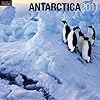
Among the cold-adapted plants and animals surviving there are penguins, fur seals, krill, mosses, lichen, and numerous types of algae; several dinosaur fossils have been found.
There is no evidence of pre-historic indigenous populations and the current semi-permanent human residents are there for scientific purposes living in a number of government supported research stations; several children have been born on the Antarctica mainland. The activities on Antarctica are managed by the 1961 Antarctic Treaty that neither denies or gives recognition to existing territorial claims.
The name Antarctica comes from the Greek antarktikos which means ‘opposite of the Arctic’ (and arctic = Gr. arktos for “bear” describing the Ursa Major constellation and the North Star).
The prominent constellation in opposition to the North Star is the Southern Cross. The Southern Ocean surrounds Antarctica though some scientists prefer to call the area the southern Pacific, Atlantic and Indian Oceans.
The existence of a land mass to “balance” the Northern Hemisphere was conjectured by thinkers as early as Ptolemy in first century CE, and European maps would show a large southern land mass until Captain James Cook's voyages.
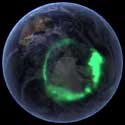
Aurora Aurtralis
NASA Earth Observatory
In 1820, three separate expeditions (Bellingshausen, Bransfield, Palmer) saw the Antartic landmass for the first time, in 1839 the Charles Wilkes Expedition reported a sighting a landmass (an area now known as Wilkes Land), John Ross sighted the ice shelf that bears his name in 1841, and Mercator Cooper probably landed in 1853. Roald Admundsen, a Norwegian explorer, was the first to reach geographic South Pole in December of 1911; Englishman Robert F. Scott was second, in January 1912.
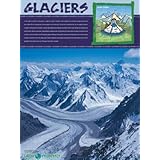
RadarSat Fills in the Blanks, Elevation of Ice Sheet, Measurements of a Paradox, Ice on the Move, Ultimate Winds, Sea of Ice, Shifting Shorelines, Continent for Cooperations. - poster text -
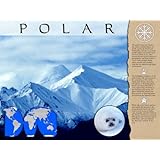
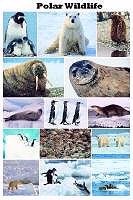
Polar Biome Poster Text: The polar biomes are found at the coldest, windiest places on Earth, the Poles, and also on the top of the world's highest mountains. Characterized mainly by ice, these extreme biomes receive almost no precipitation, and fresh water is scarce. No sunlight during winter months and relentless wind are also typical in this harsh environment.
The forbidding conditions of the polar biomes still cannot prevent the occurence of life. In the Arctic polar biome over 100 species of flowering plants, lichens and mosses flourish at every opportunity. However, in the Antarctic polar home, no plants inhabit the interior, but three species of flowering plants are found on the Antarctic coast.
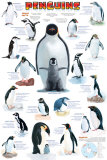
While only a few insects and bacteria inhabit the interior of the antarctic polar biome, the Antarctic coast is home to whales, seals, penguins and other birds. In the Arctic polar biome mammals, such as polar bears, seals, walruses and numerous bird species live for a portion of the year.
The Bellingshausen Sea is named for Russian naval officer Fabian Gottlieb von Bellingshausen (b. 9-20-1778, Estonia; d. 1-13-1852) who commanded the second Russian expedition to circumnavigate the globe. During this expedition Bellingshausen became one of three Europeans to first see the continent of Antarctica on January 26-7, 1820. The second was Edward Bransfield, a captain in the British Navy, just 3 days later on 1-30-1820.
The Icebreaker Nathaniel B. Palmer and Palmer Station, located on Anvers Island north of the Antarctic Circle, are named for the first American, seal hunter Nathaniel B. Palmer (b. 10-8-1799; d. 6-21-1877), to see Antartica on November 17, 1820. Connecticut born “Captain Nat” was also a captain and owner of trading clipper ships in the mid 1800s.
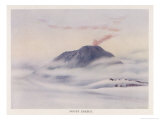
Antarctica's Mount Erebus (12,448 ft), the southernmost active volcano on Earth, is part of the Pacific Ring of Fire. Erebus is located on Ross Island and first observed by polar explorer James Clark Ross in 1841 who named the volcano after his ship, the HMS Erebus.
FYI - The HMS Erebus was also John Franklin's ship in his ill-fated exploration of the Arctic.
In Greek mythology Erebus was the son of Chaos, often interchanged with Tartarus and Hades, and associated with the underworld.
The first dinosaur (Antarctopelta oliveroi) ever discovered in Antarctica was found on James Ross Island in 1986; since then several other dinosaur fossils have been found in Antarctica.
James Ross Island (JRI), a large island off the southeast side and near the northeastern extremity of Antarctic Peninsula, should not be confused with Ross Island in McMurdo Sound. JRI was charted in October 1903 and named for Sir James Clark Ross, leader of a British expedition. The Weddell Sea is named for British naval captain James Weddell (1787-1834).
In December 1839, the Charles Wilkes expedition (EX EX) sailed from Sydney into the Antarctic Ocean and reported the discovery “of an Antarctic continent west of the Balleny Islands” at about the same time as French naval officer Jules Dumont d'Urville.
French naval officer Jules Dumont d'Urville, explorer of the south and western Pacific, Australia, New Zealand, and Antarctica, named the coast he sighted in 1837 after his wife Adelie. The French research station is named Dumont d'Urville Station.
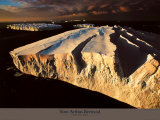
Yann Arthus-Bertrand, the photographer of this image, is an avid environmental activist, raising awareness for sustainable living for over a decade.
Robert F. Scott b. 6-6-1868; England
d. 3-29-1912; Ross Ice Shelf, Antarctica
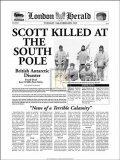
Robert Falcon Scott, a Royal Naval Officer, was the second to reach the South Pole after Roald Amundsen. Scott and his companions perished on the trip back to their base camp.
Irishman Sir Ernest Henry Shackleton's most famous expedition to the Antarctic was an attempt to cross the continent from the Weddell Sea, south of the Atlantic, to the Ross Sea, south of the Pacific, by way of the Pole.
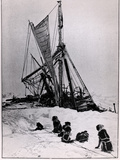
He and 28 member crew set out from London in August 1914 on the Endurance which was eventually trapped by pack ice, and finally broken on 27 October 1915, in the Weddell Sea. The crew members fled to Elephant Island (named for the elephant seals) with three small boats; then Shackleton and five other men managed to reach the southern coast of South Georgia Island in one of the boats. Shackleton was able to rescue all of the stranded crew from Elephant Island without loss, more than two years after embarking from London, and in the middle of the Antarctic winter, with the help of the Chilean Navy.
Krill are small crustaceans found in all oceans of the world. They are an important part of the food chain, feeding on phytoplankton and in turn are food for fish, penguins, seals, and whales.
Climate change is threatening the survival of krill.
The common name krill comes from the Norwegian word krill meaning “young fry of fish”.
I have searched the web for visual, text, and manipulative curriculum support materials - teaching posters, art prints, maps, charts, calendars, books and educational toys featuring famous people, places and events - to help teachers optimize their valuable time and budget.
Browsing the subject areas at NetPosterWorks.com is a learning experience where educators can plan context rich environments while comparing prices, special discounts, framing options and shipping from educational resources.
Thank you for starting your search for inspirational, motivational, and educational posters and learning materials at NetPosterWorks.com. If you need help please contact us.