|
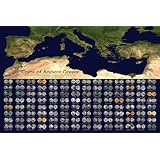
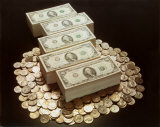
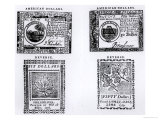
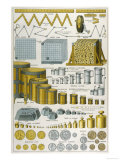
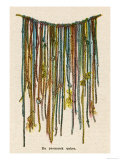
Posters depicting money, the tokens used for exchange, storage and measuring unit value, for classrooms and offices. Image include forms of currency - coins and banknotes (paper bills), the art of making money, minting coins.
Did you know that Sir Isaac Newton was the Warden of the Royal Mint?
• “If I had enough money, I would take busloads of people out to the fields and into the labor camps. Then they'd know how that fine salad got on their table.” ~ Roberto Acuna, farm worker
• “Economic growth may one day turn out to be a curse rather than a good, and under no conditions can it either lead into freedom or constitute a proof for its existence.” ~ Hannah Arendt
• “I may sometimes be willing to teach for nothing, but if paid at all, I shall never do a man's work for less than a man's pay.” ~ Clara Barton
• “A corporation, essentially, is a pile of money to which a number of persons have sold their moral allegiance.” ~ Wendell Berry
• “Being asked by a young nobleman, what was become of the gallantry and military spirit of the old English nobility, (Johnson) replied, "Why, my Lord, I'll tell you what is become of it; it is gone into the city to look for a fortune.” ~ James Boswell
• “In our researches on the likely economic apocalypse it's become clear what is the prime survival tool for hard times: friends. Good friends. Lots of them.” ~ Stewart Brand, Whole Earth Epilog (1974)
• “The challenge is to build a new economy and to do it at wartime speed before we miss so many of the nature's deadlines that the economic system begins to unravel.” ~ Lester Brown
• “For anything worth having one must pay the price; and the price is always work, patience, love, self-sacrifice - no paper currency, no promises to pay, but the gold of real service.” ~ John Burroughs
• “It has been said that the love of money is the root of all evil. The want of money is so quite as truly.” ~ Samuel Butler
• “I think the person who takes a job in order to live - that is to say, for the money - has turned himself into a slave.” ~ Joseph Campbell
• “We have become ninety-nine percent money mad. The method of living at home modestly and within our income, laying a little by systematically for the proverbial rainy day which is due to come, can almost be listed among the lost arts.” ~ George Washington Carver
• “It is my mission to help in the breaking down of classes, and to make all men feel as if they were brethren of the same family, sharing the same rights, the same capabilities, and the same responsibilities. While my hand can hold a pen, I will use it to this end; and while my brain can earn a dollar, I will devote it to this end.” ~ Lydia Maria Child
• “I think it is worse to be poor in mind than in purse, to be stunted and belittled in soul, made a coward, made a liar, made mean and slavish, accustomed to fawn and prevaricate, and ‘manage’ by base arts a husband or a father, — I think this is worse than to be kicked with hobnailed shoes.” ~ Frances Power Cobbe
• “Business, that's easily defined; it's other people's money.” ~ Alexandre Dumas, père
• “One must be poor to know the luxury of giving.” ~ George Eliot
• “Wealth consists not in having great possessions, but in having few wants.” ~ Epictetus
• “Fortune favors the audacious.” ~ Erasmus
• “Great eagerness in the pursuit of wealth, pleasure, or honor, cannot exist without sin.” ~ Erasmus
• “Make money your god and it will plague you like the devil.” ~ Henry Fielding
• “Remember that time is money.” ~ Benjamin Franklin, Advice to a Young Tradesman
• “There needs to be bolder thinking, ... on how to measure the quality of life of men and women in the work force. Currently, success is measured by material advancements. We need to readjust the definition of success to account for time outside of work and satisfaction of life, not just the dollars-and-cents bottom line.” ~ Betty Friedan
• “Money is time. With money I buy for cheerful use the hours which otherwise would not in any sense be mine; nay, which would make me their miserable bondsman.” ~ George Gissing
• “If there's no money in poetry, neither is there poetry in money.” ~ Robert Graves
• “Fame is a vapor, popularity an accident, riches take wings, only one thing endures and that is character.” ~ Horace Greeley
• “While boasting of our noble deeds we're careful to conceal the ugly fact that by an iniquitous money system we have nationalized a system of oppression which, though more refined, is not less cruel than the old system of chattel slavery.” ~ Horace Greeley
• “I pity the man who wants a coat so cheap that the man or woman who produces the cloth will starve in the process.” ~ Benjamin Harrison
• “The loss of wealth is loss of dirt, as sages in all times assert; The happy man's without a shirt.” ~ John Heywood
• “A penny for your thought.” ~ John Heywood
• “Adversity makes men, and prosperity makes monsters.” ~ Victor Hugo
• “A propensity to hope and joy is real riches; one to fear and sorrow, real poverty.” ~ David Hume
• “In a consumer society there are inevitably two kinds of slaves: the prisoners of addiction and the prisoners of envy.” ~ Ivan Illich
• “Homo economicus was surreptitiously taken as the emblem and analogue for all living beings. A mechanistic anthropomorphism has gained currency. Bacteria are imagined to mimic “economic” behavior and to engage in internecine competition for the scarce oxygen available in their environment. A cosmic struggle among ever more complex forms of life has become the anthropic foundational myth of the scientific age.” ~ Ivan Illich
• “The re-establishment of an ecological balance depends on the ability of society to counteract the progressive materialization of values. The ecological balance cannot be re-established unless we recognize again that only persons have ends and only persons can work towards them.” ~ Ivan Illich
• “The household has become the place where the consumption of wages takes place.” ~ Ivan Illich
• “The almighty dollar, that great object of universal devotion throughout our land, seems to have no genuine devotees in these peculiar villages; and unless some of its missionaries penetrate there, and erect banking houses and other pious shrines, there is no knowing how long the inhabitants may remain in their present state of contented poverty.” ~ Washington Irving, The Creole Village
• “Generally, when a man raised an expecially fine dog, some day it would stop being a dog and instead would become something on four legs that was worth money.” ~ Eric Knight, Lassie
• “I once met an economist who believed that everything was fungible for money, so I suggested he enclose himself in a large bell-jar with as much money as he wanted and see how long he lasted.” ~ Amory Lovins
• “In bourgeois society capital is independent and has individuality, while the living person is dependent and has no individuality.” ~ Karl Marx
• “Capital is dead labor, which, vampire-like, lives only by sucking living labor, and lives the more, the more labor it sucks.” ~ Karl Marx
• “What most people don't seem to realize is that there is just as much money to be made out of the wreckage of a civilization as from the upbuilding of one.” ~ Margaret Mitchell
• “Life shouldn't be printed on dollar bills.” ~ Clifford Odets
• “If you want to see what God thinks of money, just look at all the people He gave it to.” ~ Dorothy Parker
• “If your daily life seems poor, do not blame it; blame yourself that you are not poet enough to call forth its riches; for the Creator, there is no poverty.” ~ Rainer Maria Rilke
• “All these young millionaires were anarchists, of course: when a man possesses everything it is the supreme luxury for him to deny society: for in that way he can evade his responsibilities.” ~ Romain Rolland
• “Always try to rub up against money, for if you rub up against money long enough, some of it may rub off on you.” ~ Damon Runyon
• “The race is not always to the swift, nor the battle to the strong, but that's how the smart money bets.” ~ Damon Runyon
• “A little thought and a little kindness are often worth more than a great deal of money.” ~ John Ruskin
• “Guard well within yourself that treasure, kindness. Know how to give without hesitation, how to lose without regret, how to acquire without meanness.” ~ Geroge Sand
• “Simplicity is the most difficult thing to secure in this world; it is the last limit of experience and the last effort of genius.” ~ Geroge Sand
• “A great fortune is a great slavery.” ~ Seneca
• “Labour was the first price, the original purchase – money that was paid for all things. It was not by gold or by silver, but by labour, that all the wealth of the world was originally purchased; and its value, to those who possess it, and who want to exchange it for some new productions, is precisely equal to the quantity of labour which it can enable them to purchase or command.” ~ Adam Smith
• “Rich folks always talk hard times.” ~ Lillian Smith
• “I've been rich and I've been poor. It's better to be rich.” ~ Gertrude Stein
• “We are corrupted by prosperity.” ~ Tacitus
• “America... just a nation of two hundred million used car salesmen with all the money we need to buy guns and no qualms about killing anybody else in the world who tries to make us uncomfortable.” ~ Hunter S. Thompson
• “Fame is a vapor, popularity is an accident, riches take wings, those who cheer today may curse tomorrow and only one thing endures - character.” ~ Harry S Truman
• “When it is a question of money, everybody is of the same religion.”~ Voltaire
• “Let us put our money together; let us use our money; Let us put our money out at usury among ourselves, and reap the benefit ourselves.” ~ Maggie Lena Walker
• “The trouble with the profit system has always been that it was highly unprofitable to most people.” ~ E. B. White
• “America was established not to create wealth but to realize a vision, to realize an ideal - to discover and maintain liberty among men.” ~ Woodrow Wilson
• “For the love of money is a root of all kinds of evil. Some people, eager for money, have wandered from the faith and pierced themselves with many griefs.” ~ 1 Timothy 6:10, New International Version (©1984)
|