|
|
|
|
|
|
|
BOOKS ABOUT LABOR AND UNIONS
|
|
|
|
|
|
|
|
|
|
|
|
|
|
|
|
|
|
|
|
|
|
|
|
|
|
|
|
|
|
|
 |
|
|
|
Labor History Posters: Slavery, pg 4/4
for the social studies and literature classrooms, homeschoolers, & office decor.
|
social studies > Images of Labor 1 | Labor History 2 | 3 | 4 SLAVERY | money
|
|
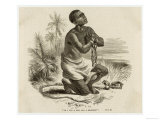
Slavery, a form of forced labor in which people are considered to be, or treated as, the property of others. Slaves, who are held against their will from the time of their capture, purchase or birth, are deprived of
- the right to leave,
- the right to refuse to work, or
- to receive compensation, like wages.
Slavery, which has existed in one form or another through all of recorded human history:
- ancient Greece - Aesop was a slave.
- as reported in the Biblical Book of Exodus with Moses leading the Israelite slaves out of ancient Egypt,
- ancient Rome,
- Medieval Europe,
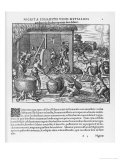
- enslavement of indignious people to mine silver in South America
- the transatlantic slave trade, beginning in the mid-1400s, when Europeans began to capture people from Africa's western and southern lands. These traders then hearded them onto ships bound for the Americas. No one is sure how many Africans were involved in the slave trade – estimates range from 10 million to 28 million.
- Today - Slavery in Mauritania is an entrenched phenomenon that the national government has repeatedly tried to abolish, banning the practice in 1905, 1981, and August 2007.
The Slave Trade, 1440 to 1800s - “Africa, like many other parts of the world, had a long tradition of slavery. But the story changed significantly in the mid-1400s, when Europeans began to capture people from Africa's western and southern lands. These traders then hearded them onto ships bound for the Americas. No one is sure how many Africans were involved in the slave trade – estimates range from 10 million to 28 million. This trade continued even after Europe and the U.S. both banned the importation of African slaves. Some say the slave trade really only stopped at the end of the 19th century.” ...
• Black History posters
• “If these slaves had only any future, anything to hope for, to strive for, to live for, any prospect before them, then I should not deplore their lot but nothing, nothing.” ~ Fredrika Bremer, Homes of the New World
• “The duty I owe to the slave, to truth, and to God, demands that I should use my pen and tongue so long as life and health are vouchsafed to me to employ them, or until the last chain shall fall from the limbs of the last slave in America and the world.” ~ William Wells Brown
• “I think the person who takes a job in order to live - that is to say, for the money - has turned himself into a slave.” Joseph Campbell
• “I thank God, I shall never again visit a slave-country.” ~ Charles Darwin
• “To be one's 'deliberate self’ is to rise above the impulse to ‘become the slaves of our passions’ and instead to act with ‘courageous devotion’ to a moral cause.” ~ Will Durant
• “If we should ever get to Heaven, we shall find nobody to reproach us for being black, or for being slaves.” ~ Jupiter Hammond
• “We produce in a panic, consume like crazy, waste blindly, and man is degraded to a consumption machine. Nuclear energy is probably meant to reinforce this most dangerous of all enslavements.” ~ Friedensreich Hundertwasser
• “In a consumer society there are inevitably two kinds of slaves: the prisoners of addiction and the prisoners of envy.” ~ Ivan Illich
• “I have no idea of submitting tamely to injustice inflicted either on me or on the slave. ~ Lucretia Mott
• “From whatever aspect we regard the question, the right of slavery is null and void, not only as being illegitimate, but also because it is absurd and meaningless. The words slave and right contradict each other, and are mutually exclusive. It will always be equally foolish for a man to say to a man or to a people: “I make with you a convention wholly at your expense and wholly to my advantage; I shall keep it as long as I like, and you will keep it as long as I like.” ~ Jean-Jacques Rousseau
• “A great fortune is a great slavery.” ~ Seneca
• “Work without love is slavery.” ~ Mother Teresa
• “I have been forty years a slave and forty years free, and would be here forty years more to have equal rights for all.” ~ Sojourner Truth
• “I am not an absolute pacifist, because I can't rule out the possibility that under some, carefully defined circumstances, some degree of violence may be justified, if it is focused directly at a great evil. Slave revolts are justified, and if John Brown had really succeeded in arousing such revolts throughout the South, it would have been much preferable to losing 600,000 lives in the Civil War, where the makers of the war — unlike slave rebels — would not have as their first priority the plight of the black slaves, as shown by the betrayal of black interests after the war. Again, the Zapatista uprising seems justified to me, but some armed struggles that start for a good cause get out of hand and the ensuing violence becomes indiscriminate. Each situation has to be evaluated separately, for all are different. In general, I believe in non-violent direct action, which involve organizing large numbers of people, whereas too often violent uprisings are the product of a small group. If enough people are organized, violence can be minimized in bringing about social change.” ~ Howard Zinn
|
|
Bartolome de las Casas
b. 8-24-1484; Seville, Spain
d. 7-17-1566; Madrid
Bartolome de las Casas, Dominican priest and the first resident Bishop of Chiapas came to the defense of the indigenous peoples after witnessing the slavery, torture and genocide of the Native Americans by the Spanish colonists.
“There were 60,000 people living on this island [when I arrived in 1508], including the Indians; so that from 1494 to 1508, over three million people had perished from war, slavery and the mines. Who in future generations will believe this?” • In Defense of the Indians: The Defense of the Most Reverend Lord, Don Fray Bartolome de las Casas, of the Order of Preachers, Late Bishop of Chiapa
• more Notable Historians
|
|
|
|
|
|
|

Incidents in the Life of A Slave Girl
History Through Literature
Art Print
sorry, no longer available
|
Incidents in the Life of a Slave Girl -
Harriet Jacobs
b. 1813; Edenton, NC
d. 3-7-1897; Washington, DC
Harriet Jacobs spent seven years hiding in a crawl space to avoid the advances of her owner and still be close enough to hear the voices of her children, before escaping North. She wrote her autobiography, Incidents in the Life of A Slave Girl, to awaken Northern women to the abuses done to female slaves.
Quote Appearing on This Print:
“The bill of sale!? Those words struck me like a blow. So I was sold at last! A human being sold in the free city of New York!... I well know the value of that bit of paper, but much as I love freedom, I do not like to look upon it. I am deeply grateful to the generous friend who procured it, but I despise the miscreant who demanded payment for what never rightfully belonged to him or his.”
The quote refers to Cornelia Willis, her employer and friend, buying her freedom for $300 in 1852.
• History Through Literature posters
• women author posters
|
|
|
|
Elizabeth Hobbs Keckley (Keckly)
b. February 1818; Virginia
d. May 1907; Washington, DC
A former slave who became a successful seamstress, Elizabeth Keckley, authored her autobiography, Behind the Scenes or, Thirty Years a Slave and Four Years in the White House, about her time as Mary Todd Lincoln's personal modiste and confidante.
|
|
|
|
|
|
|
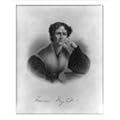
Frances “Fanny” Wright
b. 9-6-1795; Dundee, Scotland
d. 12-13-1852; Cincinnati, OH after falling on icy stairs.
Frances “Fanny” Wright was a lecturer, writer, freethinker, feminist, abolitionist, and social reformer.
As an experiment in utopian ideals she founded the Nashoba Commune (near Memphis, TN) in 1825, the same year she became a US citizen. The commune was a test project to educated and emanicpate slaves were no slaveholders would lose money for freeing slaves. The venture failed.
• Fanny Wright: Rebel in America
|
|
|
|
|
|
|
|
previous page | top | Images of Labor 1 | Labor History 2 | 3 | 4 SLAVERY | money
Frederick Douglass | Sojourner Truth | Harriet Tubman
|
|
I have searched the web for visual, text, and manipulative curriculum support materials - teaching posters, art prints, maps, charts, calendars, books and educational toys featuring famous people, places and events - to help teachers optimize their valuable time and budget.
Browsing the subject areas at NetPosterWorks.com is a learning experience where educators can plan context rich environments while comparing prices, special discounts, framing options and shipping from educational resources.
Thank you for starting your search for inspirational, motivational, and educational posters and learning materials at NetPosterWorks.com. If you need help please contact us.
|
|
|