|
|
|
|
|
|
|
|
|
|
|
|
|
|
|
|
|
|
|
|
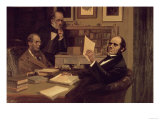
Joseph Dalton Hooker, botanist and explorer, and Charles Lyell, geologist and popularizer of uniformitarianism, with Charles Robert Darwin.
|
|
|
|
|
|
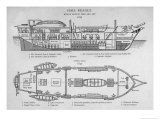
The Beagle Channel, a strait in the Tierra del Fuego archipelago of extreme southern South America, was named after the HMS Beagle. On the 1830 voyage Darwin befriended Jemmy Button, a young Fuegian being returned to the southern tip of South America, and later wrote about their time together on The Beagle.
|
|
|
|
|
|
Evolution Poster
“In the broadest sense, evolution is merely change.”
Douglas Futuyma
• more motivational posters
|
|
|
|
|
|
Biosphere: Adaption & Biodiversity
An adaptation is a change in the structure of function of an organism which allows it to thrive within its environment. ...
Biological diversity, or biodiversity, is the variety of all living organisms. ...
|
|
|
|
|
|
|
|
|
|
|
|
|
|
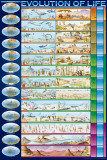
Evolution of Life Chart Poster
Precambrian, Paleozoic, Mesozoic, Cenozoic stages illustrations.
• more biology posters
|
|
|
|
|
|
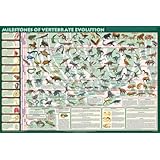
Milestones of Life Chart Poster
|
|
|
|
|
|
Voices of Reason
“I cannot persuade myself that a beneficent and omnipotent God would have designedly created parasitic wasps with the express intention of their feeding within the living bodies of Caterpillars.” Charles Darwin
|
|
|
|
|
|
The Galapagos Islands are a Pacific Island archipelago of volcanic islands distributed around the equator about 600 miles west of continental South America.
The islands are famed for their vast number of species unique to the location (endemic), and the studies by Charles Darwin during the voyage of the ‘Beagle’ that contributed to his theory of evolution by natural selection.
FYI - The word galapagos is from the Spanish “galápago”, “saddle”— after the shells of giant tortoises. Also the Galapagos are a province of Ecuador and part of their national park system.
|
|
|
|
|
|
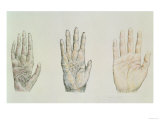
Hands of a primate and a human
|
|
|
|
|
|
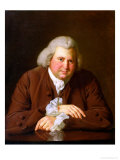
Portrait of Dr Erasmus Darwin (1731-1802) scientist, inventor, poet, grandfather of Charles Darwin.
|
|
|
|
|
|
|
|
|
|
|
|
|
|
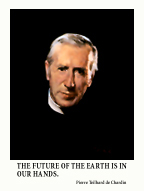
Pierre Teilhard de Chardin
Pierre Teilhard de Chardin, a French philosopher, palentologist and Jesuit, believed that evolution is an incomplete process. He has become known for his theory that man is evolving, mentally and socially, toward a final spiritual unity.
|
|
|
|
CHARLES DARWIN BOOKS, VIDEO, AUDIO
Origin of the Species sold out on the first day of its publication in 1859. It is the major book of the nineteenth century, and one of the most readable and accessible of the great revolutionary works of the scientific imagination.
At the time of its publication the book raised havoc among scientists and the general public - and it still does today. “Descended from the apes? My dear, let us hope that it is not true, but if it is, then let us pray that it will not become generally known,” said the wife of the bishop of Worcester after she had learned about The Origin of Species.
At the age of twenty-two (1831), Darwin - who was a geologist, zoologist, paleontologist and botanist - was invited to go on a journey around the world on the H.M.S. Beagle. The ship's captain, ironically hoped that a trained naturalist would return with arguments to counter the new “dangerous” evolutionary views that were then beginning to shock European religious fundamentalists. On that now famous trip, Darwin made expeditions hundreds of miles inward, through different countries, often risking his life to collect and observe the fauna, flora, and geological formations. The result was The Origin of Species, some twenty-three years later. It took that long for Darwin's theories to come together and for the impact of all he had seen to fall into place.
In The Origin of Species, Darwin aimed to show the probability that every species is a development from previous species, which clearly implies that humans could have evolved from earlier and different forms of life. Darwin believed that all living things are engaged in a fierce “struggle for existence” and that the severe conditions of life tend to kill off those animals or plants that inherit unforvorable traits, thus ensuring the survival of the fittest. Darwin concluded that there exists a “natural selection” of favorable variations that, in the course of thousands of years, succeeds in producing a remarkable variety of life forms through the process of evolution.
The Origin of Species was the first mature and persuasive work to explain how species change through the process of natural selection. Upon its publication, the book began to transform attitudes about society and religion, and was soon used to justify the philosophies of communists, socialsits, capitalists, and even Germany's National Socialsits. But the most quoted response came from Thomas Henry Huxley, Darwin's friend and also a renowned naturalist, who exclaimed, “How extremely stupid not to have thought of that!” [front/back flaps]
The Descent of Man - In The Descent of Man Charles Darwin focused special attention on the origin and history of our own species, a subject he had avoided in his previous writins on evolution. He claimed tht the human animal is closest in ancestry to the two African pongids, or anthropoid apes (chimpanzees and gorillas). Further, Darwin held that our species and these two pongids differ merely in degree rather than in kind - a controversial view that contradicted religious doctrine. The Descent of Man looks at the emergence of humans in terms of primate evolution. Darwin presents a strictly mechanistic and materialist interpretation of our species that is free from superstition and spiritualism. [back cover]
The Voyage of the Beagle: Charles Darwin's Journal of Reserches- When the Beagle sailed out of Devonport on 27 December 1831, Charles Darwin was twenty-two and setting off on the voyage of a lifetime. It was to last five years and transform him from an amiable and somewhat aimless young man into a scientific celebrity. Even more vitally, it was to set in motion the intellectual currents that culminated in the arrival of The Origin of Species in Victorian drawing-rooms in 1859. His journal, reprinted here in a shortened version, is vivid and immediate, showing us a naturalist making patient observations, above all in geology. As well as a profusion of natural hisotry detail, it records many other things that caught Darwin's eye, from civil war in Argentina to the new colonial settlements of Australia, The editors have provided an excellent introduction and notes, maps and appendices, including an essay on scientific geology and the Bible by Robert FitzRoy, Darwin's frined and captain of the Beagle. [back cover]
The Autobiography of Charles Darwin (1809-1882) - Charles Darwin's Autobiography was first published in 1887, five years after his death. It was a bowdlerized edition: Darwin's family, attempting to protect his posthumous reputation, had deleted all the passages they considered too personal or controversial. The present complete edition did not appear until 1959, one hundred years after the publicaton of The Origin of Species. [back cover]
Evolution: The Triumph of an Idea by Carl Zimmer- Companion volume to PBS series tells the story of the theory of evolution -- from Darwin to twenty-first-century science.
Charles Darwin's The Origin of Species was breathtaking, beautifully written, staunchly defended, defiantly radical. Yet it emerged long before paleontologists and geologists worked out the chronology of life on Earth, long before biologists uncovered the molecules that underlie heredity and natural selection. Not until the late twentieth century was the true scope of its power revealed.
This book, featuring more than 150 color illustrations, presents a rich and up-to-date view of evolution that explores the far-reaching implications of Darwin's theory and emphasizes the power, significance, and relevance of evolution to our lives today. After all, we ourselves are the product of evolution, and we can tackle many of our gravest challenges -- from the lethal resurgence of antibiotic-resistant diseases to the wave of extinctions that looms before us – with a sound understanding of the science. It can help us see our lives in connection to everything that has come before and to every form of life on Earth today.
Filled with rich narrative, award-winning science writing, and the most up-to-date information on topics ranging from Darwinian medicine and sexual selection to the origins of language, evolutionary psychology, and the controversies surrounding creationism, Evolution tells in riveting detail the story of a remarkable scientific journey, from the emergence to the triumph of an idea. [book description]
Evolution, boxed set [video] - A journey into where we’re from and where we’re going.
Evolution is happening all around you--in your body, your backyard, your local hospital, and in the products that make it to your grocery store shelves. Perhaps no other scientific theory has as far reaching an effect on our daily lives as evolution, yet it is one of the most overlooked and misunderstood principles of life. Driven by two simple mechanisms, variation and natural selection, evolution is the process that helps determine who lives, who dies, and who gets the opportunity to pass on traits to the next generation, and the next, and the next ...
Evolution, a groundbreaking 7-part, 8-hour series, travels around the world to examine evolutionary science and the profound effect it has on society and culture. From the genius and torment of Darwin to the vast changes that spawned the tree of life and from the role of mass extinction in the survival of species to the power of sex to drive evolutionary change, Evolution explores the emergence of consciousness, the success of humans and the perceived conflict between science and religion in understanding human life. Evolution is fascinating and far-reaching in scope.
The Genius of Charles Darwin, DVD
An Essay on the Principle of Population
by T. R. Malthus - Malthus's classic warning against overpopulation, first published in 1798, was available to Darwin. The essay examines the tendency of human numbers to outstrip their resources, and argues that checks in the form of poverty, disease, and starvation are necessary to keep societies from moving beyond their means of subsistence. Malthus's argument was controversial in his time; today his name has become a byword for active concern about humankind's demographic and ecological prospects, and his theories brought into question because he did not sample large populations over long periods of time. [Malthus portrait]
Savage: The Life and
Times of Jemmy Button (Orundellico)
c. 1815-1864; Tierra del Fuego
(book description) In 1830 a Yamana Indian boy, Orundellico, was bought from his uncle in Tierra del Fuego for the price of a mother-of-pearl button. Renamed Jemmy Button, he was removed from his primitive nomadic existence, where life revolved around the hunt for food and the need for shelter, and taken halfway round the world to England, then at the height of the Industrial Revolution. He learned English and Christianity, met King William IV and Queen Adelaide, and made a strong impression on many of the major figures in Britain, eventually becoming a celebrity. Charles Darwin himself befriended the Fuegian and later wrote about their time together on The Beagle, voyaging back to the southern tip of South America. Their friendship influenced one of the most important and controversial works of the century, On the Origin of the Species.
Upon his return to Tierra del Fuego, Jemmy found that life could never be the same for him there. The Beagle's captain deposited the young man on a lonely, windswept shore and charged him with the tasks of “civilizing” his people and bringing God to his homeland. At first ostracized and attacked by other Fuegians, Jemmy later became the target of zealous and ambitious missionaries. Thirty years after his return, a missionary schooner in Tierra del Fuego was attacked, with nearly everyone on board killed, and Button himself was accused of leading the massacre.
Button's life story illustrates how the lofty ideals of imperialism often resulted in appalling consequences. Thoroughly researched and remarkably well written, this fascinating and poignant story is ultimately about survival, revenge, murder, and the destruction of a whole race of people, blurring the boundaries of civilization and savagery.
LINKS FOR LEARNING : CHARLES DARWIN
- The Darwin Foundation - Founded in 1959, under the auspices of UNESCO and the International Union for Conservation of Nature and Natural Resources (previously World Conservation Union), the Charles Darwin Foundation is dedicated to the conservation of the Galapagos ecosystems. The Foundation operates the Charles Darwin Research Station to conduct scientific research and environmental education for conservation. The Station has a team of over two hundred scientists, educators, volunteers, research students and support staff from all over the world. The Foundation Secretary General is located in Quito, the capital of Ecuador, and maintains close contact with the government to promote Galapagos conservation throughout Ecuador.
- Charles Darwin-Wikipedia - the free encyclopedia
- BBC Education Evolution Website - THE MAN AND HIS LEGACY, THE ORIGIN ONLINE, BIBLIOGRAPHY, DEBATE, ALIFE LIFE ON EARTH, EXTINCTION FILES, FOSSIL ROADSHOW, NATURAL SELECTIONS
- The Darwin Correspondence Project - The Darwin Correspondence Project exists to publish the definitive edition of letters to and from Charles Darwin, the most influential naturalist of the 19th century: intended for both scholars and general readers.
- Evolution - PBS - The Evolution project's goals are to heighten understanding of evolution and how it works, to dispel common misunderstandings, to illuminate why it is relevant to our lives, to improve its teaching, to encourage a national dialogue, and to prompt participation in all aspects of the project.
- Understanding Evolution - Understanding Evolution is a non-commercial, education website, teaching the science and history of evolutionary biology. This site is here to help you understand what evolution is, how it works, how it factors into your life, how research in evolutionary biology is performed, and how ideas in this area have changed over time.
- National Center for Science Education - Defending the Teaching of Evolution in the Public Schools
- The Victorian Web - All about the Victorian Era- literature, history, technology...
- Project Gutenberg, Charles Darwin - Project Gutenberg is the oldest producer of free electronic books (eBooks or etexts) on the Internet. Collection of more than 13.000 eBooks was produced by hundreds of volunteers. Most of the Project Gutenberg eBooks are older literary works that are in the public domain in the United States. All may be freely downloaded and read, and redistributed for non-commercial use.
|