|
|
|
|
|
Thomas Banyacya
(1909-1999)
Thomas Banyacya was internationally recognized keeper of the ancient Hopi prophecy, warns of a gourd of ashes so hot it would burn a hole in the Earth - an atomic bomb.
He travelled tirelessly on behalf of the Hopi elders since the 1940s, proclaiming the importance of caring for the Earth and the value of traditional wisdom.
Teaching a Native American worldview that everything has spirit, he encouraged us to enter the realm of spirit, to see as the wind sees, to talk with the animals, and to welcome everything on Earth.
He told how native people are caring for the Earth with songs and spirituals, “You will learn from us the sacredness of everything.”
Mr. Banyacya was in Lawrence, KS for the dedication on the Haskell Medicine Wheel, as were Jake Swamp and Leon Shenandoah. (On the link - you will have to scroll down the page to see an aerial image of the ceremony.)
• Thomas Banyacya
|
|
|
|
Adam Beach
b. 11-11-1972; Ashern, Manitoba, Canada
Actor Adam Beach is familiar face in movies and television - Tommy on Walker, Texas Ranger, Kickin' Wing in Joe Dirt, Marine Private First Class Ira Hayes in Flags of Our Fathers , Private Ben Yahzee in Windtalkers, Dr. Charles Eastman (Ohiyesa) in Bury My Heart at Wounded Knee, Chester Lake in Law & Order: Special Victims Unit, and Officer Jim Chee in the film adaptions of Skinwalkers, Coyote Waits, and A Thief of Time. , Private Ben Yahzee in Windtalkers, Dr. Charles Eastman (Ohiyesa) in Bury My Heart at Wounded Knee, Chester Lake in Law & Order: Special Victims Unit, and Officer Jim Chee in the film adaptions of Skinwalkers, Coyote Waits, and A Thief of Time.
Beach is a member of the First Nation Saulteaux, a branch of the Ojibwa nation.
|
|
|
|
James Beckwourth
b. 4-6-1798/1800; Frederick Co., Virginia
d. 10-29-1886; Denver
James Beckwourth, the son of a slave woman and her master, Sir Jennings Beckwith, became a blacksmith, explorer and scout, fur trapper, a war chief in the Crow Nation.
Beckwourth Pass and Trail, between Reno and Portola, California, is named after him. In 1851 James Beckwourth lead a wagon train through the pass that bears his name and among his “passengers” was a young girl who became the first Poet Laureate of California, Ina Coolbrith.
FYI ~ While Sir Beckwith treated James as a son, James was still considered a slave. After the family moved from Virginia to Missouri around 1809, James received a formal education in St. Louis, and the father had James emancipation recorded three times, in 1824, 1825, 1826.
|
|
|
|
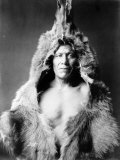
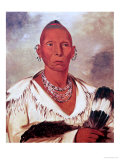
Bear's Belly was born in 1847, at Ft. Clark in present day North Dakota. His story of being a scout for George Armstrong Custer, and of how he acquired his bear skin, is included in Curtis' biographical sketches in The North American Indian.
The Arikara, a semi-nomadic agricultural group living in the Great Plains in present day Dakotas, were decimated by smallpox in the late 1830s.
|
|
|
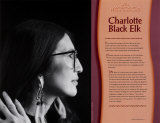
Charlotte Black Elk
Contemporary Native Americans
poster no
longer available
|
Charlotte Black Elk
b. 1951; Pine Ridge Reservation
In the Lakota Sioux religion, the Black Hills are the most sacred of all places. Hear those hills, on the Pine Ridge Reservation, lives Charlotte Black Elk, the great granddaughter of the famous Lakota spiritual leader Nicholas Black Elk (1863-1950).
Charlotte was born on the reservation in 1951. She spoke only the Lakota language until first grade. But when she started school her family encouraged her to learn English. “We were told to learn it better than white people,” she says, “so that no one cold ever lie to us in a language we didn't understand.”
Ms. Black Elk's tribe has been lied to before. The U.S. government had promised the Sioux that their sacred lands, the Black Hills, would never be taken away. But in 1874, gold was discovered in the Black Hills, and the government broke its promise and took control of the area. Today, Ms. Black Elk is campaigning to get these lands returned to her tribe. She is working to educate people about the Black Hills, their importance to the Sioux, and the treaties the U.S. government broke. To keep her heritage alive, she has passed her Lakota language and religion on to the children. “I was told my generation would make its own choices to remain Lakota or choose to walk away.” she has written. “I'm confident of our survival as a people.”
• Black Elk Speaks: Being the Life Story of a Holy Man of the Oglala Sioux
• Principles of Humanity- Peace, with quote from Nicholas Black Elk
|
|
|
|
Black Hawk (1767-1838)
Poster Text: “[Black Hawk] has done nothing for which an Indian ought to be ashamed. He has fought for his countrymen, the squaws and papooses, against white men, who came year after year, to cheat and take away their lands. You know the cause of our making war. It is known to all white men. They ought to be ashamed of it.”
Speech upon surrender, Prairie du Chein, Wisconsin (August 27, 1832) -Poster no longer available.
Black Hawk was a Sauk Indian chief. His tribe lived in the northwestern part of present-day Illinois. White settlers tricked the Sauk into signing away their land, but Black Hawk refused to recognize the sale of his home. During the Black Hawk War in 1832, the Sauk fought for the right to live on their land west of the Mississippi River, but they lost. Black Hawk's tribe was the last to live in the Illinois region.
• FYI - Abraham Lincoln was part of a militia unit in the Black Hawk War.
• Black Hawk: An Autobiography
|
|
|
|
Blue Jacket (Weyapiersenwah)
b. c. 1743; present day Ohio
d. c. 1810
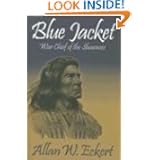
Weyapiersenwah, or Blue Jacket, was a war chief of the Shawnee people. He is best remembered for his militant defense of Shawnee lands in the Ohio Country and an important predecessor of the famous Shawnee leader Tecumseh.
On August 20, 1794, Blue Jacket's confederation of Native American tribes was defeated by the American forces lead by Major Anthony Wayne at the Battle of Fallen Timbers, south of present-day Toledo, Ohio. Blue Jacket was compelled to sign the Treaty of Greenville on August 3, 1795, ceding much of present-day Ohio to the United States.
|
|
|
|
Joseph Brant
b. 1742; Ohio, near present day Akron
d. 11-24-1807; Ontario, Canada
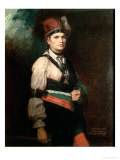
Joseph Brant (Thayendanegea), a Mohawk leader and British military officer during the American Revolution, is remembered in US history for his attacks on settlers in on the western frontier and in Canada for trying to regain indigenous lands.
Brant, perhaps the most well-known North American Indian of his generation, met both George Washington and King George III. His portrait was painted by English artist George Romney, 1775-1776.
• Joseph Brant- Man of Two Worlds
|
|
|
|
Buckongahelas
b. c. 1720; present day Delaware
d. May 1805; Indiana (smallpox or influenza)
Lenape chief, councilor and warrior Buckongahelas, over the course of his life, led his band from the place of his birth to the White River area to near present-day Muncie, Indiana.
Buckongahelas resisted white expansion from the time of the French and Indian War (Seven Years' War) through the Northwest Indian Wars. In the late 1780s, he joined a Shawnee-led confederacy, lead by his friend Blue Jacket, to try to repel the American settlers who were using the Ohio River to penetrate westward. The confederacy was eventually defeated at the Battle of Fallen Timbers on August 20, 1794.
|
|
|
|
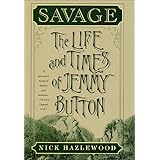
Jemmy Button (Orundellico)
c. 1815-1864; Tierra del Fuego
(book description) In 1830 a Yamana Indian boy, Orundellico, was bought from his uncle in Tierra del Fuego for the price of a mother-of-pearl button. Renamed Jemmy Button, he was removed from his primitive nomadic existence, where life revolved around the hunt for food and the need for shelter, and taken halfway round the world to England, then at the height of the Industrial Revolution. He learned English and Christianity, met King William IV and Queen Adelaide, and made a strong impression on many of the major figures in Britain, eventually becoming a celebrity. Charles Darwin himself befriended the Fuegian and later wrote about their time together on The Beagle, voyaging back to the southern tip of South America. Their friendship influenced one of the most important and controversial works of the century, On the Origin of the Species.
Upon his return to Tierra del Fuego, Jemmy found that life could never be the same for him there. The Beagle's captain deposited the young man on a lonely, windswept shore and charged him with the tasks of “civilizing” his people and bringing God to his homeland. At first ostracized and attacked by other Fuegians, Jemmy later became the target of zealous and ambitious missionaries. Thirty years after his return, a missionary schooner in Tierra del Fuego was attacked, with nearly everyone on board killed, and Button himself was accused of leading the massacre.
Button's life story illustrates how the lofty ideals of imperialism often resulted in appalling consequences. Thoroughly researched and remarkably well written, this fascinating and poignant story is ultimately about survival, revenge, murder, and the destruction of a whole race of people, blurring the boundaries of civilization and savagery.
|
|
|
previous page | top | next
List Notable Native Americans > a | B | c | d-e-f-g | h-i-j | k-l | m | n-o-p-q | r | s | t-v-w-x-y-z
|
|
I have searched the web for visual, text, and manipulative curriculum support materials - teaching posters, art prints, maps, charts, calendars, books and educational toys featuring famous people, places and events - to help teachers optimize their valuable time and budget.
Browsing the subject areas at NetPosterWorks.com is a learning experience where educators can plan context rich environments while comparing prices, special discounts, framing options and shipping from educational resources.
Thank you for starting your search for inspirational, motivational, and educational posters and learning materials at NetPosterWorks.com. If you need help please contact us.
|
|
|
|