|
|
|
|
|
|
|
BOOKS ABOUT THE MAYA & MAYAN CULTURE
|
|
|
|
|
|
|
|
|
|
|
|
|
|
|
|
|
|
|
|
|
|
|
|
|
 |
|
|
|
|
|
Maya Indians and Mayan Culture Posters, Prints & Charts
for the social studies classroom, home schoolers, and themed decor for office and studio.
|
social studies > Native Americans > MAYA INDIANS & MAYAN CULTURE POSTERS < Central America
|
|
The Mayas, a sophisticated, technologically advanced civilization indigenous to Central America, reached their zenith between the 4th and 12th centuries A.D.
The Mayas were accomplished in math and astronomy, having formulated complex calendars and writing systems before the Spanish colonial conquest.
The Mayan civilization eventually succumbed to plagues, internal wars, and droughts, much that was foretold by their own prophecies.
The ancient Maya created one of the most sophisticated and prophetic calendar systems. High priests foretold events 5,126 years into the future to what some believe will be the end of the world in 2012.
|
|
|
|
|
|
|
The Maya
(500 B.C. – 900 A.D.)
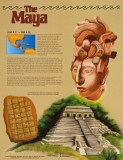
The Maya Indians built one of the world's most remarkable civilizations in the jungles of Central America. Like the ancient Greeks, who civilization was nearing its peak just as the Maya appeared, the Maya are known for their fabulous temples, and for their amazing knowledge of math and science. The Maya were the only Indians in America to develop a written language. Today, people come from all over the world to view the crumbling ruins of their once-great cities.
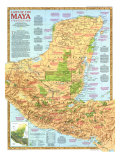
The Maya lived throughout Central America's Yucatan Peninsula in what are now the nations of Mexico, Guatemala, and Belize. They were a short, stocky people, with dark skin and black hair. They greatly admired sloping foreheads, and would frequently strap boards to babies' heads in order to flatten them. Maya life centered around the great cities, which were used for festivals, markets, and religious ceremonies. Strangely enough, almost no one lived in the cities. Only priests were allowed to live there for short periods of time. All other people lived in smaller communities around the cities, or on farms scattered throughout the countryside. The Maya grew crops such as corn, beans, squash, and tomatoes. They liked to dance, and they played a difficult game in which players had to hit a ball through a stone ring with their knees or hips.
Like the Greeks, the Maya worshipped many gods. They had rain gods, a sun god, a corn god, and gods of death and the underworld. The Maya were very interested in measuring and studying time. They invented a highly accurate calendar, which they used to help them track the movements of the sun, stars, and planets. Maya civilization began to decline around 800, as the Maya abandoned their cities one by one. Even today, no one really knows why this remarkable civilization suddenly ended.
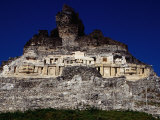
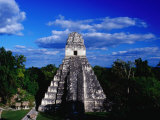
Artwork depicts the Temple of the Inscriptions at Palenque, statue of the Maya leader Lord Pacal, and the Mayan calendar.
• more Ancient Civilizations posters
• Honduras posters
• Your Travel Guide to Ancient Mayan Civilization
|
|
|
|
|
|
|
|
|
|
|
|
|
Poetry Forms -
Epic Poster
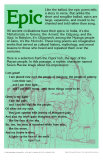
Like the ballad, the epic poem tells a story in verse. But unlike the short and songlike ballad, epics are large, expansive, and meant to be chanted and told rather than sung.
All ancient civilizations have their epics: in India, it's the Mahabarata, in Greece, the Aeneid, the Odyssey, and the Iliad, in Babylon, it's Gilgamesh; among the Nyanga people of Zaire, it's the Mwindo. These long poems are imaginative works that served as cultural history, mythology, and moral lessons to those who heard and repeated them over the centuries. ...
Here is a selection from the Popol Vuh, the epic of the Mayan people. In this passage, a mythic character named Seven Macaw brags about his importance:
I am Great!
I am placed now over the people of masonry, the people of pottery.
I am their sun, /and I am their light, / and I am their moon, until those things come to be.
Great is my light! / I am the path, / and I am the trail for the people.
Of silver are my eyes, / they just sparkel with jewelry of bluegreen jade.
And also my teeth gape bluegreen with stones,/ like the face of the sky.
So, too, my nose is scorched-white from afar, / like the moon.
And my throne is silver,/ it lights up the face of the earth. ...
|
|
|
previous page | top
social studies > Native Americans > MAYA INDIANS & MAYAN CULTURE POSTERS < Central America
|
|
I have searched the web for visual, text, and manipulative curriculum support materials - teaching posters, art prints, maps, charts, calendars, books and educational toys featuring famous people, places and events - to help teachers optimize their valuable time and budget.
Browsing the subject areas at NetPosterWorks.com is a learning experience where educators can plan context rich environments while comparing prices, special discounts, framing options and shipping from educational resources.
Thank you for starting your search for inspirational, motivational, and educational posters and learning materials at NetPosterWorks.com. If you need help please contact us.
|
|
|
|