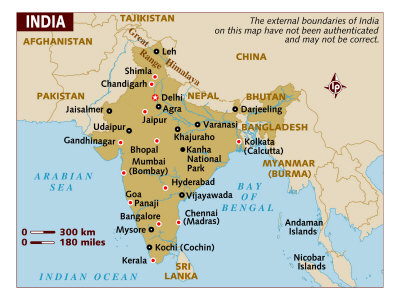
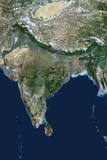
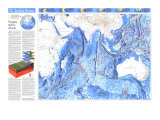
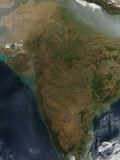
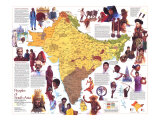
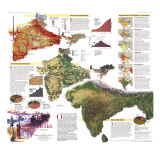
India, on the Indian tectonic plate sits on a “sub-continent” as it pushes into Asia forming the Himalaya Mountains to its north and juts into the Indian Ocean to the south, with the Arabian Sea on the west and the Bay of Bengal on the east.
India, the seventh-largest country by geographical area, is the second-most populous country, and the most populous democracy, in the world. India is bordered by Pakistan to the west, the People's Republic of China, Nepal, and Bhutan to the north, and Bangladesh and Myanmar to the east. India has a coastline of 4,700 miles with the countries of Sri Lanka, the Maldives and Indonesia in the Indian Ocean.
306 MILLION YEARS AGO: Supercontinent Pangaea dominates the globe. ... 237 MILLION YEARS AGO: India is wedged between Antarctica and Africa. ... 130 MILLION YEARS AGO: The ancient Tethys Sea closes and the Indian Ocean opens. ... 70 MILLION YEARS AGO: India begins its sprint to the north. ... more text
The Deccan Plateau of India is the result of enormous floods of lava breaking through Earth's crust towards the end of the Cretaceous period, between 67 and 65 million years ago. The eruption is known as the Deccan Traps.
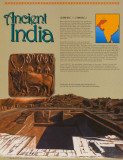
Ancient India
(2500 B.C. — 1500 B.C.)
When historians talk about India, they usually mean the area that now includes Pakistan and Bangladesh, as well as modern India. It was in this region, just south of the world's tallest, and most rugged moutains, that one of the great civilizations of ancient times flourished. This civilization is known as the Indus Valley civilization, because it grew up along the Indus River in the north. Like the Nile and the Tigris and the Euphrates Rivers, the Indus River flooded its banks every year, creating a rich soil on which farmers could grow crops.
Around the year 2500 B.C., at the same time the Egyptians were building the great pyramids, the first cities rose up in the Indus Valley. The largest of these cities were Harappa and Mohenjo-Daro. Each of these cities had more than 30,000 people. And each was carefully planned, with streets that ran north-south and east-west, like a grid. They were surrounded by impressive walls made of rock-hard mud bricks. Experts have found ruins of a public storage house for grain in both cities, suggesting that the Indus Valley people had some kind of organized government. The people of Harappa and Mohenjo-Daro wre also very concerned with cleanliness. They disposed of the garbage by pushing it through narrow slits cut into the walls of houses, where it fell into special containers lined up outside. Most of the Indus Valley people were farmers. They grew wheat, barley, rice, and cotton to make cloth. Trade was also very important. The Indus people used special clay seals like the one shown here to mark packages of goods.
Around 1500 B.C., this remarkable civilization began to show signs of decline. No one really knows why. Some experts say the Indus River may have changed course, leaving the cities stranded. Others say the Indus Valley people may have overfarmed the soil and been forced to abandon their homes. But the most likely reason is that other peoples invaded from the north and killed off or enslaved the Indus Valley dwellers.
Artwork depicts the ruins of the public bath at Mohenjo-Daro, and one of the many clay seals used by Indus Valley peoples to mark packages.
“The truth is one; sages call it by various names.” – Rig Veda
Hinduism is the oldest of the world's major religions. It developed as a combination of ancient Indian religions and the religion of the Aryans. The Aryans were nomads who invaded northern India between 2000 and 900 B.C. Hindus worship many different gods and goddesses, but these gods and goddesses are all part of Brahman, the absolute and supreme realty. Hindus believe that everything – all things and events – plays a role in universal order. Today, Hinduism is the major religion of India. More that 760 million Hindus live in India and around the world.
The Vedas – which means “body of knowledge” – are the most honored texts in Hinduism. the Upanishads [oo-PAHN-ih-shads], an important part of the Vedas, explain the concept of Brahamn. The Upanishads also discuss reincarnation, the belief that when a person dies, his or her soul is reborn in another living being. Hindus compare the soul to a river. Like a river, the soul flows continuously, but it is always the same. Other Hindu holy texts tell the stories of gods and goddesses. The three most important Hindu gods are Brahma, the creator; Vishnu, the preserver, and Siva, the destroyer. Individual devotion to a personal god is a major part of modern Hindu worship.
The Vedas also set up a “caste system,” a formal division of people into different social classes. Hindus believe that good actions in one life can lead to rebirth in a higher caste in the next life. A person's caste is determined by karma, the consequences of human actions. During the 1800s people started to work against the caste system because it denied basic rights to many. Under the caste system, “Untouchables,” people of the lowest social class, had to perform the worst jobs and couldn't use such public facilities as roads and wells. One man who led the struggle to end this system was the Hindu religious and political leader Mohandas K. Gandhi. Gandhi also helped India gain independence from Great Britain in 1947.
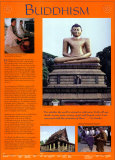
World Religions - Buddhism “For whether the world is eternal or otherwise, birth, old age, death, sorrow, pain, misery, grief, and despair exist. I am concerned with the extinction of these.” The Buddha
Buddhism developed from the teachings of Siddhartha Gautama, a Hindu prince from northern India who lived from 563 to 483 B.C. Siddhartha came to be known as the Buddha, or “the enlightened one.” One of the central beliefs of Buddhism is that suffering always exists in the world. The Buddha taught that the only way to avoid suffering is to understand it and its source – desire. Today about 350 million Buddhists live all around the world. Most Buddhist live in the Asian nations of Japan, China, and Vietnam, but many live in the U.S.
As a young prince, Siddhartha enjoyed a life of luxury in his father's palace. But he grew curious about the world outside the palace walls. When he left the palace, he discovered a world filled with suffering. He thought he might find freedom from suffering by giving up the material comforts of life. He soon realized that self-denial was no more helpful to him in his quest than the luxury of the palace was. So, Siddhartha shifted his lifestyle to the “middle path” – he tried to live a life of neither self-denial nor excess. Doing so helped him to concentrate and understand the world around him. Finally, he gained enlightenment, or complete understanding. ...
World Religions -
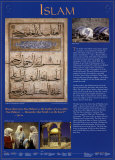
Islam Wall Poster “Know that every True Believer is the brother of every other True Believer. ...Remember that Faith is in the heart.” Qur'an
The Arabic word “Islam” means peace, purity, acceptance and commitment. People who follow the Islamic religion are called Muslims. Islam in monotheistic that is, Muslims believe there is only one God. They believe Muhammad is the final and most important prophet, or messenger, of God, who is called Allah. But Muslims do not think of Muhammad as God. Muhammad lived from 570 to 632. He established Islam in Mecca, Saudi Arabia. His followers spread Islam from Mecca throughout the Arab world and beyond. The early Muslims converted people who lived in the lands the controlled in Arabia, North Africa, and Spain. Today, Islam is the world's second-largest religion – more than one billion Muslims live in the Middle East and around the world.The Qur'an lists five duties that all Muslims must fulfill – these are known as the Five Pillars of Faith. Performing these duties makes up much of the day-to-day religious practice of Muslims. The first duty is shahadah, or testimony that “There is no god but Allah, and Muhammad is his prophet!” The next is salah, or prayer. Devout Muslim pray five times daily. The third duty is zakah, the giving of alms, or charity, to the poor. The fourth duty is sawm, or fasting. Muslims fast during the month of Ramadan, the time when Muhammad received the Qur'an. The final duty is hajj, or pilgrimage. If they are able, Muslims must visit the holy city of Mecca at least once in their lives. ...
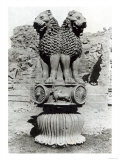
Emperor Ashoka flourished - 304-232 BC; Pataliputra, Patna, India
Ashoka ruled almost all of the Indian subcontinent from what is now Afghanistan and possibly eastern Iran, through the Hindu Kush mountains to present-day Bangladesh and as far south as northern Kerala and Andhra Pradesh.
Ashoka embraced Buddhism after witnessing the destruction and mass deaths he caused in wars of conquest. He is known today as a devotee of ahimsa (nonviolence), love, truth, tolerance, vegetarianism, and as a philanthropic administrator.
The pillars of Ashoka are a series of columns dispersed throughout the northern Indian subcontinent. The pillars, quarried just south of Varanasi, are an average forty and fifty feet in height and weigh up to fifty tons each. They were dragged, sometimes hundreds of miles, to where they were erected.
The Lion Capital of Ashoka, placed atop a pillar at Sarnath, has been adopted as the National Emblem of India, and the wheel “Ashoka Chakra” from its base is the image at the center of the National Flag of India.
Poster Text: Mother Teresa, a Roman Catholic nun who devoted her life to caring for others, was awarded the Nobel Peace prize in 1979. Her work with the poorest people of India made her one of the most beloved and honored figures in the world. But she always insisted that her greatest reward was her work. She once described herself as “a little pencil in the hand of God”. ...
Sanskrit, a historical Indo-Aryan language, is one of 22 official India languages, a liturgical language of Hinduism and Buddhism, and a declared a Classical Language in India.
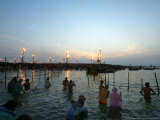
Ganges River, the most sacred river to Hindus, is one of the populated places on Earth - about one in every 12 people on Earth (8.5% of world population) live in the catchment area of the Ganges.
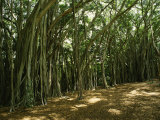
It is a spreading tropical fig tree that propagates from seeds dropped by bird. The seeds will sprout where they land and send out aerial roots that develop into additional trunks.
The lotus, an aquatic perennial, is the national flower of India. Lotus root in the soil of a pond or river bottom with the leaves floating on the surface and the flower heads rising above the water.
The lotus in Hindu religion represents purity and divine beauty; in Buddhism the lotus represents purity of the body, speech, and mind above the muddiness of attachment and desire.
The Himalaya Mountains, meaning “abode of snow” in Sanskrit, one of the classical languages of India, separates the Indian subcontinent from the Tibetan Plateau.
The Himalayans contain the Earth's highest peaks and many are sacred to Hinduism and Buddhism.
Cobras are snakes with the ability to raise the front quarters of their bodies off the ground and flatten their necks to appear larger to a potential predator.
Mongooses are small carnivores that are sometimes domesticated to control vermin. The Rudyard Kipling's fictional story Rikki-Tikki-Tavi features a pet mongoose that saves its human family from two deadly cobras.
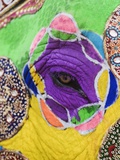
The Asian Elephant (Elephas maximus) is a species of elephant formerly known as the Indian Elephant. It is smaller than its African relatives, the easiest way to distinguish the two is the smaller ears of the Asian Elephant.
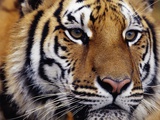
The Bengal Tiger or Royal Bengal Tiger (Panthera tigris tigris), is the national animal of India. It is a subspecies of tiger found throughout the subcontinent's rainforests and grasslands.
Afghanistan | Armenia | Azerbaijan | Bahrain | Bangladesh | Bhutan | Brunei | Burma | Cambodia China | East Timor (Timor Timur) | Georgia | Hong Kong | India | Indonesia | Iran | Iraq | Israel Japan | Jordan | Kazakhstan | North Korea | South Korea | Kuwait | Kyrgyzstan | Laos | Lebanon
Macau | Malaysia | Maldives | Mongolia | Myanmar | Nepal | Oman | Pakistan | Papua New Guinea
Philippines | Qatar | Russia | Saudi Arabia | Singapore | Sri Lanka | Syria | Taiwan | Tajikistan Tibet | Thailand | Turkey | Turkmenistan | United Arab Emirates | Uzbekistan | Vietnam | Yemen
I have searched the web for visual, text, and manipulative curriculum support materials - teaching posters, art prints, maps, charts, calendars, books and educational toys featuring famous people, places and events - to help teachers optimize their valuable time and budget.
Browsing the subject areas at NetPosterWorks.com is a learning experience where educators can plan context rich environments while comparing prices, special discounts, framing options and shipping from educational resources.
Thank you for starting your search for inspirational, motivational, and educational posters and learning materials at NetPosterWorks.com. If you need help please contact us.