|
|
|
|
|
|
|
BOOKS ABOUT LABOR AND UNIONS
|
|
|
|
|
|
|
|
|
|
|
|
|
|
|
|
|
|
|
|
|
|
|
|
|
|
|
|
|
|
|
 |
|
|
|
Labor History Educational Posters, pg 2/4
for the social studies and literature classrooms, homeschoolers, & office decor.
|
social studies > Images of Labor 1 | Labor History 2 | 3 | slavery 4
|
|
Images on this page include medieval peasants revolt, John Ball, Bartolome de las Casas, Luddites, Tolpuddle Martyrs, Chartists, Lowell Mill Girls, Great Railroad Strike of 1877, Haymarket Affair, Homestead Strike and Lockout, Pullman Strike, the Triangle Shirtwaist Fire, Hawk's Nest Incident, protests against child labor, and May Day prints.
|
“Everyone has the right to work, to free choice of employment, to just and favourable conditions of work and to protection against unemployment.” Article 23.1 of the Universal Declaration of Human Rights
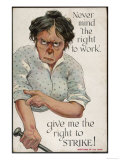
A strike, labors’ most powerful weapon to force concessions from employers, is not undertaken lightly. The hardships of no pay or benefits for the duration of the strike, and permanent unemployment, are risks and hardships a worker is willing to endure in order to acquire better wages and /or conditions. The right to strike is then a form of free speech in bargaining.
By making strikes illegal businesses removed the bargaining power of the strikers and would continue to operate only for the interest of corporation privilege.
“I believe a rich plunderer like Pullman is a greater felon than a poor thief, and it has become no small part of the duty of this organization to strip the mask of hypocrisy from the pretended philanthropist and show him to the world as a oppressor of labor. One of the general officers of the company said today that you could not hold out against the Pullman Company more than ten days longer. If it is a fact that after working for George M. Pullman for years you appear two weeks after your work stops, ragged and hungry, it only emphasizes the charge I made before this community, and Pullman stands before you as a self confessed robber . . . . The paternalism of Pullman is the same as the interest of a slave holder in his human chattels. You are striking to avert slavery and degradation.
Eugene V. Debs, Speech to Pullman Strikers, May 16, 1894, reported by Stead, Chicago Today, pp. 177-78
• The Pullman Strike: The Story of a Unique Experiment and of a Great Labor Upheaval
Labor Day is a legal holiday observed in the United States, Puerto Rico, the Canal Zone, and the Virgin Islands. The holiday in honor of the working class was initiated in the U.S. in 1882 by the Knights of Labor, and the first Labor Day holiday was celebrated in New York City, in accordance with the plans of the Central Labor Union. The second Labor Day holiday just a year later in 1883 and in 1884 the first Monday in September was selected as the date. The Central Labor Union urged similar organizations in other cities to follow their example of a “workingmen’s holiday”. The idea spread with the growth of labor organizations and in 1885 Labor Day was celebrated in many industrial centers of the country.
|
|
|
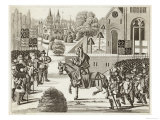
The English peasants revolt of 1381 was a major event in the medieval history of England, marking the beginning of the end of serfdom. The English King, Richard II, was only 14 years old at the time of the revolt, and “negiotiated the peace”. [Did you know that the first literary mention of “Robin Hood” was in the allegorical narrative “Piers Plowman”, written c. 1380?]
|
|
John Ball, one of the leaders of the revolt, was a roving preacher expounding the doctrines of John Wycliffe and insisting on social equality.
A contemporary of Richard II was poet Geoffrey Chaucer; Richard II was also the title character in Shakespeare's 1595 play, Richard II.
|
|
|
|
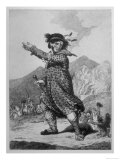
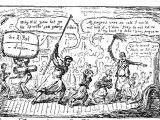
The name Luddite refers to those who destroyed stocking machines that were eliminating jobs and traditional pricing practices for skilled textile workers c. 1811, and has come to refer to anyone who is opposed to technological change.
|
|
|
|
The Tolpuddle Martyrs were a group of 19th century British labourers who were arrested and convicted for swearing a secret oath as members of the Friendly Society of Agricultural Labourers. Their punishment for forming a trade union was to be transported to the penal colony of Australia.
William Cobbett's 1830 Rural Rides is a social commentary on the English agrarian life.
|
|
|
|
The Chartists were possibly the first working class movement in the world, taking their name from the People's Charter of 1838 that called for six reform measures:
• universal male suffrage for all men over the age of 21 (not women)
• electoral districts of equal size
• secret ballots
• end property qualification for Parliament
• pay members of Parliament
• Parliament selected by annual election
|
|
|
|
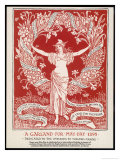
A Garland for May Day • 1895 Dedicated to the Workers by Walter Crane, was the cover of The Clarion, a penny Socialist weekly.
The artist Walter Crane was closely associated with the Socialist movement and did as much as his colleague William Morris, to bring art into the daily life of all classes.
His “cartoon” (in red, a color associated with socialist movements) features a female figure holding a large wreath of flowers tied with scrolls of inscribed with socialistic mottoes in the spirit of ‘Merrie England’” -
“No people can be free while dependent for their bread.” • “The plough is a better backbone than the factory.” • “No child Toilers.” • “Production for use, not for profit.” • “Solidarity of Labour.” • “The cause of Labour is the Hope of the World.” • “Socialism means the most helpful, hopeful Life for All.” • “A Commonwealth when Wealth is Common.” • “Art and Enjoyment for All.” • “Hope in Work & Joy in Leisure.” “Cooperation & Emulation, not Competition.” • “Shorten working Day and Lengthen Life.” • “England should feed her own People.” • “The Land for the People.”
|
|
|
|
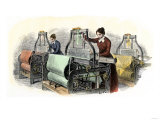
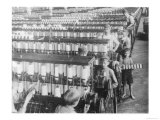
Lowell Mill Girls were the female textile workers in 19th century Lowell, Massachusetts, named after Francis Cabot Lowell, a mill owner. Lowell became the center of textile manufacturing and the industrial revolution in the United States.
Three quarters of the mill workforce was female who worked in a system of large-scale mechanization and lived under the strict eye of the mill owners in company boarding houses.
Initially the mills paid generous wages for the time, but when tough economic times came in the early 1830s, wage reductions were proposed which resulted in a “turn-out”. The strike failed but was an indication of the willingness of the women, thought to be manageable, to organize for their mutual benefit.
• Lowell Mill Girls
|
|
|
|
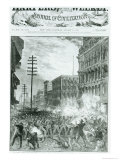
The Great Railroad Strike of 1877 was in response to the second cutting or railroad workers wages in a year. State and local militias, as well as federal troops put down the strike that was brought on by the significant economic depression in Europe in the early 1870s. The European depression put the top US investment banking company of Jay Cooke into failure. As Cooke was the primary backer to the Northern Pacific Railroad and other railroad companies, the US economy collapsed in what is called the Panic of 1873. Part of the cause of the economic collaspe was “the unregulated (editor emphasis) growth, especially in the railroad industry, with the government giving massive land grants and subsidies to railroads. Thus, the massive overbuilding of the nation’s railroads, and the overinvestment by bankers of depositors’ funds in the railroads laid the foundation for the Panic and the depression that followed.” It lasted till 1879.
• The Great Strikes of 1877
|
|
|
|
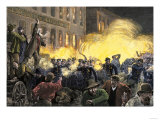
Haymarket Affair, Chicago, May 4, 1886, began as one of several rallies staged around May 1 in large US cities supporting a standard eight-hour day for workers.
The peaceful rally was winding down when the police moved in and pipe bomb was thrown. A police officer was killed in the explosion, the police drew guns and fired, the crowd may or may not have been armed - the result was the death of seven officers and sixty wounded mostly by their own bullets, an unknown number of workers were killed or wounded.
Eight anarchists were tried for murder with four executed (one was Albert Parsons). The trial and conviction of the eight anarchists is one of the most serious miscarriages of justice. On June 26, 1893, Illinois Governor John Peter Altgeld said the real reason for the bombing was the city of Chicago's failure to hold Pinkerton guards responsible for two earlier shooting of workers and concluded all eight defendants were innocent. The pardons he signed ended his political career.
• Death in the Haymarket: A Story of Chicago, the First Labor Movement and the Bombing that Divided Gilded Age America
|
|
|
|
The Homestead Strike & Lockout
One of the most serious labor disputes in U.S. history occurred in the Pennsylvania town of Homestead. On July 6, 1892, a union strike and company lock-out resulted in a battle between the Amalgamated Association of Iron and Steel Workers (AA) and the Pinkerton National Detective Agency hired by the Carnegie Steel Company to protect the physical plant.
• The Homestead Steel Strike of 1892
|
|
|
|
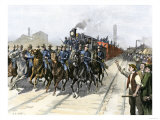
The Pullman Strike
The Pullman Strike, which brought rail traffic to a halt wes of Chicago in May of 1894, started as a wildcat strike in response to the Pullman Palace Car Company instituted a 25% wage cut due to poor national economic conditions, without a corresponding cut in rents for homes in the company town.
Eventually other railroad unions refused to handle any Pullman car, shutting down the railways and bringing in the federal government under the reasoning that the US Mail wasn't being delivered, the strike represented a threat to public safety, and that a federal injunction to end the strike was ignored.
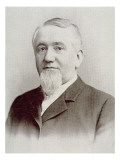
On first glance the Pullman Company appeared to be a model employer whose company town rented houses complete with plumbing, gas, and sewer system, with free education to the eighth grade, a public library, company stores, and open spaces, for the company workers. The truth was the workers expenses for living under the paternistic watchful eye of George Pullman could exceed the wages and they were in perpetual debt to the company, with little or no choice on how they spent their earnings.
This closed system of bartering labor for commodities is called a ‘truck’ system (from the French troquer meaning exchange) and favored the employer; in many jurisdictions it has been made illegal.
Eugene V. Debs was the head of the American Railway Union and was sentenced to six months in jail on an ignoring the federal injunction charge.
“I believe a rich plunderer like Pullman is a greater felon than a poor thief, and it has become no small part of the duty of this organization to strip the mask of hypocrisy from the pretended philanthropist and show him to the world as a oppressor of labor. One of the general officers of the company said today that you could not hold out against the Pullman Company more than ten days longer. If it is a fact that after working for George M. Pullman for years you appear two weeks after your work stops, ragged and hungry, it only emphasizes the charge I made before this community, and Pullman stands before you as a self confessed robber . . . . The paternalism of Pullman is the same as the interest of a slave holder in his human chattels. You are striking to avert slavery and degradation.
Eugene V. Debs, Speech to Pullman Strikers, May 16, 1894, reported by Stead, Chicago Today, pp. 177-78
In 1898 the Illinois Supreme Court force the Pullman Company to divest in the company town after a national commission studying the strike concluded the Pullman paternalism partly to blame.
• The Pullman Strike: The Story of a Unique Experiment and of a Great Labor Upheaval
|
|
|
|
The Triangle Shirtwaist Factory fire in New York City on March 25, 1911, caused the death of 146 garment workers who either died from the fire or jumped to their deaths. It was the worst workplace disaster in New York City until September 11, 2001.
Other events reported was a train accident, a boat sinking, preparation for war and children planting trees.
|
|
|
|
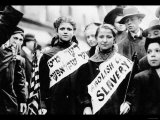
Protest against Child Labor.
One young woman's banner reads Abolish Child Slavery in English.
|
|
|
|
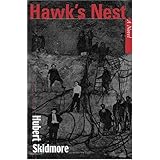
The contruction of the Hawks Nest Tunnel was the worst industrial incident in American history.
From a West Virginia Historical Marker - “Construction of nearby tunnel, diverting waters of New River through Gauley Mt for hydroelectric power, resulted in state's worst industrial disaster. Silica rock dust caused 109 admitted deaths in mostly black, migrant underground work force of 3,000. Congressional hearing placed toll at 476 for 1930-35. The tragedy brought recognition of acute silicosis as occupational lung disease and compensation legislation to protect workers.”
Muriel Rukeyser also wrote about the Hawks Next tragedy.
|
|
previous page | top | Images of Labor 1 | Labor History 2 | 3 | slavery 4
|
|
I have searched the web for visual, text, and manipulative curriculum support materials - teaching posters, art prints, maps, charts, calendars, books and educational toys featuring famous people, places and events - to help teachers optimize their valuable time and budget.
Browsing the subject areas at NetPosterWorks.com is a learning experience where educators can plan context rich environments while comparing prices, special discounts, framing options and shipping from educational resources.
Thank you for starting your search for inspirational, motivational, and educational posters and learning materials at NetPosterWorks.com. If you need help please contact us.
|
|
|