SOCIAL STUDIES-

20th Century America
American Experience
American Revolution
Colonial America
Founding Fathers
Ancient Civilizations
Anc. African Civilizations
anthropology
Asian Americans
aviation
banned books/authors
Bill of Rights
Black History
US Civil War
Voices of Diversity
notable educators
explorers
flags
geography
Great Thinker Quotes
Heroes Science & Tech
Heroes from History
notable historians
Historic Days
historic documents
Historic Headlines
Historic Heroes
history of art
History Through Lens
History Through Literature
Holocaust
Images of Labor
Inventions Changed World
Latinos
maps
Middle Ages
money/currency
Nation of Immigrants
Native Americans
Olympics
peace & justice
philosophers
Political Process
presidents
Stonehenge
Supreme Court
Supreme Court Justices
Technology's Past
Vietnam Era
world leaders
world's religions
World War I
World War II


CALENDARS

Aviation Calendars
Aviation Calendars

Helicopters Calendars

Ballooning Calendars


BOOKS ON AVIATION & HUMAN FLIGHT
Flight: 100 Years of Aviation
Flight: 100 Years
of Aviation

Black Wings
Black Wings:
The American Black in Aviation

Stick and Rudder
Stick and Rudder:
An Explanation of
the Art of Flying

To Conquer the Air
To Conquer the Air:
The Wright Bros. and the Great Race
for Flight

Night Flight
Night Flight

West with the Night
West with
the Night


Flight My Life in Mission Control
Flight My Life
in Mission Control

Moon Lander
Moon Lander:
How We
Developed
the Apollo
Lunar Module


Teacher's Best - The Creative Process

Aviation Educational Posters- the Science, Art & History of Flight, pg 1/2
for the classroom and home schoolers.


social studies > aviation & flight 1 | 2 | a | b | c | d | e | f-g | h-i-j-k | l | m | n-o-p-q | r | s | t-u-v-w-x-y-z < science


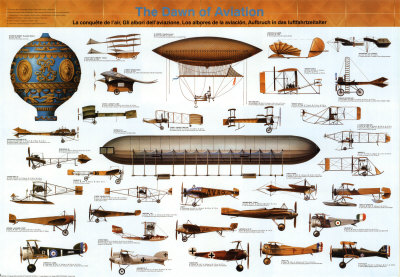
The Dawn of Aviation Fine Art Print
The Dawn of Aviation

Pioneers in aviation include the Montgolfier and Wright Brothers, hot air balloonists, gliders, parachutes, military and commericial aviation, space flight and the Greek myth of Icarus.

The word ‘aviation’ is French, from the Latin avisbird”.


A

John Alcock
Neil Armstrong
Henry “Hap” Arnold

B

Pancho Barnes
Elly Beinhorn
Jean-Pierre Blanchard
Sophie Blanchard
Louis Bleriot
William Boeing
Helene Boucher
Pappy Boyington
Jean-Marie Le Bris
Arthur Whitten Brown
Richard E. Byrd

C

Sir George Cayley
Octave Chanute
Claire Lee Chennault
Alan John Cobham
Jacqueline Cochran
Bessie Coleman
Jean Louis Conneau
Glenn Hammond Curtiss


D

Daedalus and Icarus
Benjamin O. Davis, Jr.
Jimmy Doolittle
Helene Dutrieu

E

Amelia Earhart
Hugo Eckener
Eugene Ely

F-G

Anthony Fokker
Steve Fossett

Yuri Gagarin
Henri Giffard
John Glenn
Robert H. Goddard

H-I-J-K

Geoffrey de Havilland
William Samuel Henson
Howard Huges

Amy Johnson


L

Ruth Bancroft Law
Bill Lear
Sebastien Lenomard
Charles Lindbergh
Raymonde de Laroche

M

Beryl Markham
Marie Marvingt
Wop May
Billy Mitchell
Montgolfier Bros
John Moisant

N-O-P-Q

Charles Nungesser
Edward O'Hare

Adolphe Pegoud
Wylie Post

Harriet Quimby


R

Eddie Rickenbacker
Manfred von Richthofen
Dick Rutan

S

Antoine de Saint-Exupéry
Alberto Santos-Dumont
Blanche Stuart Scott
Igor Sikorsky
Sir Thomas Sopwith
Katherine Stinson

T-U-V-W-X-Y-Z

Tuskegee Airmen

Wright Brothers

Chuck Yeager
Jeana Yeager
Count Ferdinand von Zeppelin


Quest for Flight Innovative Aviation, Poster
Quest for Flight
Innovative Aviation,
Poster

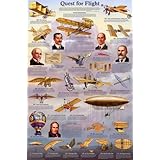
Humans have long sought to soar in the sky, just like birds. This informative and visually striking poster shows what it took to accomplish that seemingly impossible goal. The bottom row shows mans earliest attempts to fly. Moving up the poster, the most important discoveries, inventions and events are presented in chronological order. The great aviation pioneers are honored by a portrait and a brief biography. In the late 1700s, English engineer Sir George Cayley correctly identified the four forces that would affect a flying machine. A century later, Lawrence Hargrave discovered the lift provided by a cambered wing. About that time, Octave Chanute compiled and published the first organized, written collection of aviation research. He shared his knowledge with many aviation pioneers. Americans Orville and Wilbur Wright made the first controlled flight of a heavier than air machine on December 17, 1903 at Kitty Hawk, North Carolina. It flew 120 feet in 12 seconds. Their Flyer was very experimental, and it took the Wright brothers three more years to make it reasonably practical. Some of the valuable improvements made by other early aviators are incorporated in the two planes shown above the Flyer.


The Montgolfier Brothers' Balloon Experiment at the Chateau De La Muette, 21st November, 1783, Giclee Print
The Montgolfier Brothers' Balloon Experiment at the Chateau De La Muette,
21st November, 1783,
Giclee Print

The first public demonstration of a hot air balloon was made on 4th June 1783, in France by the Montgolfier Bros. Benjamin Franklin witnessed one of the Montgolfier's flights.


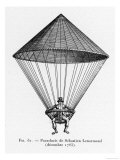
Parachute Successfully Demonstrated by Sebastien Lenormand, Giclee Print
Parachute Successfully Demonstrated by
Sebastien Lenormand,
Giclee Print

In December 1783 Sebastien Lenomard jumped from a Montpelier observatory tower in Paris with a 14’ round piece of linen cloth shaped like an umbrella. He named the device a 'parachute', Fr. parare=to shield, chute=fall. (oh- I just got 'parasol' - shield from sun.)

Leonardo da Vinci made notations of a device that would break a fall c. 1495; and in 1617 Venetian Fauste Veranzio constructed an application based on da Vinci's drawing and jumped from a tower in Venice.

The Chinese also worked on the concept of letting a person fall safely from some height c. 1200, and in 852 AD a gentleman named Armen Firman sustained only minor injuries when he lept from a tower in Cordoba using his cloak stiffened with wooden struts.


Blanchard Channel Crossing, Giclee Print
Blanchard Channel Crossing,
Giclee Print

Jean-Pierre Blanchard
b. 7-7-1753; France
d. 3-7-1809; from injuries suffered in a fall from a balloon caused by a heart attack.

French ballooning pioneer Jean-Pierre Blanchard made the first crossing of the English Channel in a balloon with Boston physician John Jefferies on 1-7-1785. He also made the first balloon flight in North America in 1793. President George Washington saw the flight, as did future US Presidents Jefferson, Madison and Monroe. His widow, Sophie Blanchard, was also a balloonist.


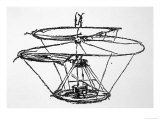
Cayley's Helicopter, Giclee Print
Cayley's Helicopter,
Giclee Print

Sir George Cayley
b. 12-27-1773; England
d. 12-15-1857; England

Sir George Cayley, described as the “father of Aerodynamics”, is best known for his “flying machines” which included gliders and small scale helicopters.


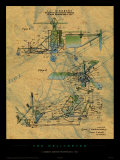
The Flying Machine, the "Ariel," from Designs Prepared by W.S. Henson, Giclee Print
The Flying Machine,
the “Ariel,” from Designs
Prepared by W.S. Henson,
Giclee Print

William Samuel Henson
b. 5-3-1812; England
d. 1888; New Jersey

W.S. “Mad-man” Henson, patented a “Henson Aerial Steam Carriage” in 1843, and formed the Aerial Transit Company to raise money to construct the machine. His scale models were never able to fly; the image of the flying machine were created to advertise the new possibility of air flight.


Le Bris's Project the Bird-Like Flying Device of Jean-Marie le Bris, Giclee Print
Le Bris's Project-
the Bird-Like Flying Device
of Jean-Marie le Bris,
Giclee Print

Jean-Marie Le Bris
b. 1817; Brittany
d. 1872

Sea captain Jean-Marie Le Bris accomplished a glider flight in 1856 with a design based on his observations of the highly efficient albatross soaring over cover great distances with little exertion.


The Flying Machine, the "Ariel," from Designs Prepared by W.S. Henson, Giclee Print
The Steam-Powered Dirigible
of Henry Giffard, Giclee Print

Henri Giffard
b. 1825
d. 1882; committed suicide because of failing eyesight

French engineer Henri Giffard invented a steam powered airship (dirigible) that made the FIRST powered and controlled flight on 9-12-1852. Giffard's contributions are commemorated as one of the 72 names on the Eiffel Tower.


A Glider Rider Jumps off a Dune at the Chanute Gliding Camp on the Shores of Lake Michigan, Giclee Print
A Glider Rider Jumps
off
a Dune at the
Chanute Gliding Camp on the Shores of Lake Michigan,
Giclee Print

Octave Chanute
b. 2-18-1832; Paris, France
d. 11-23-1910; Chicago

Octave Chanute, both an engineer and pioneer in aviation, was consulted by the Wright brothers early in their aviation endeavors because of his willingness to share his thoughts and latest development. Chanute's openess caused a rift with the Wrights when they wanted to protect their work with secrecy.

Hannibal Bridge over the Missouri River Dedication, July 3, 1869
Hannibal Bridge over the Missouri River Dedication,
July 3, 1869

Chanute designed and built the stockyards in Chicago and Kansas City, and Kansas City's Hannibal Bridge, the first bridge across the Missouri River (1869) which made KC a transportation hub. We can also thank Chanute for developing the use of creosote derived from coal tar in railroad ties and telephone poles for the purpose of preservation from decay, with the unintented consequences of health problems.

Ferdinand Adolf August Heinrich Graf Von Zeppelin German Soldier Aviator and Airship Constructor, Giclee Print
Ferdinand Adolf August Heinrich Graf Von Zeppelin, German Soldier, Aviator and Airship Constructor,
Giclee Print

Count Ferdinand von Zeppelin
b. 7-8-1838; Germany
d. 3-8-1917

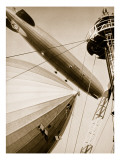
Von Zeppelin invented a buoyant airship that used a cavity filled with a gas less dense than air and manuvered with rudders and propellers. After some spectucalr accidents airships are no longer viable in commercial transportation, though most people are familiar with blimps (soft sided airships) used in advertising where the ability to hover for long periods is desirable.


Technology’s Past - Wright Brothers Wall Poster
Technology’s Past - Wright Brothers
Wall Poster

Wright Brothers

Technologies Past Text: “We were lucky enough to grow up in an environment where there was always much encouragement to children to pursue intellectual interests.” Orville Wright

The Wright's Flyer had a “tail first” arrangement. Wing-warping allowed the plane to turn, but the brothers found that a bank could cause the plane to spiral into the ground. Thy added moveable rudders to keep th turn under control.

Flying Machine Takes to the Air Poster, London Herald Headline Poster
Flying Machine Takes to the Air! Poster
London Herald,
12-18-1903

Orville and Wilbur Wright, American inventors and aviation pioneers, achieved the first powered, sustained, and controlled flight of an airplane in 1903. The brothers built two sturdier, more reliable planes in the next two years, and in 1906 received a U.S. patent for a powered aircraft.

17 December 1903 at Kitty Hawk: Flyer No. 1 rises into the air for the first time. Three flights were made that day. The longest, piloted by Wilbur, was 852 feet and took 59 seconds. ...

• more Wright Bros. posters
Technology's Past posters
Historic Headlines posters

Ten Days that Shook the Nation - First Flight of the Wright Brothers Wall Poster
First Flight of the Wright Brothers
Ten Days that Shook the Nation, Poster

Ten Days that Shook the Nation -
First Flight of the Wright Brothers December 17, 1903

Ever since Icarus donned his wings of feathers and wax, humans have dreamed of flying. But as the 20th century began, few believed people would ever fly through the air. But two young men from Dayton, Ohio, knew better. Their names were Wilbur and Orville Wright. The Wright brothers first became interested in powered flight after reading about the pioneering glider pilot Otto Lilienthal. Soon, they began experimenting with gliders and kites of their own design. On the advice of weather experts, they chose a narrow strip of sandy beach near Kitty Hawk, North Carolina for their experiments. . ...

Ten Days That Shook the Nation posters


Louis Bleriot Crossing the English Channel by Plane, 25th July 1909, Giclee Print
Louis Bleriot Crossing the English Channel by Plane, 25th July 1909,
Giclee Print

Louis Bleriot
b. 7-1-1872; France
d. 8-2-1936

Louis Bleriot, French inventor and engineer, achieved the first flight over a large body of water, the English Channel, in 1909. The flight was 22 miles and took 40 minutes.


Biplane Pioneer Pilots, Print


The Glorious Flight: Across the Channel with Louis Bleriot July 25, 1909

The "Gold Bug" Biplane Designed and Flown by Glenn Hammond Curtiss
The “Gold Bug” Biplane Designed and Flown by Glenn Hammond Curtiss, Giclee Print

Glenn Hammond Curtiss
b. 5-21-1878; Hammondsport, NY
d. 7-23-1930; Buffalo

Glenn H. Curtiss, aviation pioneer, was the winner in the world's first air meet (August 1909, France) and on May 29, 1910 he won the $10,000 first prize offered by Joseph Pulitizer for his 153 minute flight from Albany to New York City (137 miles). His victory lap was flying over Manhattan and circling the Statue of Liberty.

Curtiss Jenny Art Print
Curtiss Jenny,
Giclee Print


Curtis had the first U.S. pilot license (1911) and was the founder of the Curtiss Aeroplane and Motor Company. The Curtiss “Jenny” is associated with the training of pilots for World War I.


History Through a Lens - Hindenburg Disaster Wall Poster
Hindenburg Disaster
Wall Poster

Hindenburg Disaster,
History Through a Lens Poster

• more History Through a Lens posters


Liquid-Fuel Rocket, Inventions that Changed the World, Poster
Liquid-Fuel Rocket,
Inventions That Changed the World, Poster

Robert H. Goddard
b. 10-5-1882; Massachusetts
d. 8-10-1945

It is hard to believe, but the most important flight in the history of space travel may have been the one that took place on a Massachusetts farm on March 16, 1926. The flight lasted only 2.5 seconds and reached a height of only 41 feet. But it marked the first successful test of a new invention – the liquid fuel rocket. ...

Inventions that Changed the World posters

General Claire L. Chennault of the American Volunteer Group commands USAAF 14th Air Force in China, Photographic Print
General Claire L. Chennault
of the American Volunteer Group commands USAAF 14th Air Force in China,
Photographic Print

Claire Chennault
b. 9-6-1893; Texas (raised in Louisiana)
d. 7-27-1958; New Orleans (lung cancer)

Military aviator Claire Chennault advocated “pursuit” / fight-interceptor aircraft during the 1930s when the U.S. Army Air Corps focused primarily on high-altitude bombardment. After Chennault retired from the USAAC in 1937, he went became an aviation trainer and adviser in China, commanding the “Flying Tigers” during World War II.


Ten Days that Shook the Nation - The Moon Landing, 1969 Wall Poster
Ten Days that Shook the Nation - The Moon Landing, 1969
Wall Poster

Men Walk on the Moon - July 20, 1969

Astronauts posters
Ten Days That Shook the Nation posters


previous page | top | aviation & flight posters 1 | 2


I have searched the web for visual, text, and manipulative curriculum support materials - teaching posters, art prints, maps, charts, calendars, books and educational toys featuring famous people, places and events - to help teachers optimize their valuable time and budget.

Browsing the subject areas at NetPosterWorks.com is a learning experience where educators can plan context rich environments while comparing prices, special discounts, framing options and shipping from educational resources.

Thank you for starting your search for inspirational, motivational, and educational posters and learning materials at NetPosterWorks.com. If you need help please contact us.

NPW home | Global PathMarker Collection | APWTW Blog | faqs-about | contact | search | privacy
links for learning & curriculum ideas | bookshelves | toybox | media | ecards | quotes

NetPosterWorks.com ©2007-2011 The Creative Process, LLC All Rights Reserved.

last updated 6/18/11