|
|
|
|
|
|
BOOKS & MEDIA:
THE SUPREME COURT |
|
|
|
|
|
|
|
|
|
|
|
|
|
|
|
|
|
|
|
|
|
 |
|
|
|
|
U.S. Supreme Court Justices Educational Posters
for the classroom, home schoolers & offices.
|
social studies > SUPREME COURT JUSTICES < Supreme Court Landmarks
|
|
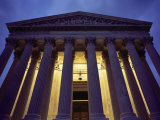
The highest judicial body of the United States is the Supreme Court (SCOTUS or USSC); it is the only court established by the United States Constitution as one of the three divisions of political power (executive and legislative). The judicial branch has the sole power to interpret the law and apply it to particular disputes, the power to determine the disposition of prisoners, and the power to compel testimony and the production of documents. There is no standard qualification of age or experience, justices are nominated by the President (executive) and confirmed with “advice and consent” of the Senate (legislative). Appointments to the US Supreme Court are for life; to leave the court a justice may resign, or a judge may be removed by impeachment. Currently the US Supreme Count consists of nine Justices: eight Associate Judges and a Chief Justice. Courts are generally known by the name of the Chief Justice.
The individuals represented on this page in chronological order:
|
|
|
|
|
|
James Wilson
b. 9-14-1742; Carskerdo, Fife, Scotland
d. 8-21-1798; NC
James Wilson, a Founding Fathers, was one of the six original justices appointed to the Supreme Court by George Washington.
|
|
|
|
John Rutledge
b. 9-17-1739; Charleston, SC
d. 6-21-1800; Charleston
John Rutledge has the unfortunate distinction of being the only U.S. Supreme Court justice to be forced out of office involuntarily, ending his public career. Appointed by George Washington during a recess, the Senate rejected his nomination in part due to apparent mental illness and alcoholism exacerbated by his wife's death in 1792.
|
|
|
|
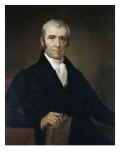
John Marshall
4th Chief Justice, 1801-1835
b. 9-24-1755; Germantown, Colony of Virginia
d. 7-6-1835; Philadelphia
Federalist John Marshall was the longest serving Chief Justice in the US Supreme Court and fourth longest-serving justice. Nominated by John Adams and serving through Andrew Jackson, Marshall's court opinions are the basis for United States constitutional law and brought the Supreme Court to being a coequal branch of government..
• Marbury v Madison poster
|
|
|
|
Roger B. Taney
5th Chief Justice, 1836-1864
b. 3-17-1777; Calvert Co., MD
d. 10-12-1864; Washington, DC
Roger Brooke Taney, the first Roman Catholic to hold the office of Chief Justice of the United States, was a champion of states rights. He is most remembered for delivering the majority opinion in Dred Scott v. Sandford. He also freed his own slaves, provided pensions for those too old to work and condemned slavery as “a blot on our national character.”
FYI - Taney married Alice Key, daughter of Francis Scott Key.
|
|
|
|
Salmon Portland Chase
6th Chief Justice, 1864-1873
b. 1-13-1808; Cornish, New Hampshire
d. 5-7-1873; NYC
Salmon P. Chase, appointed to the Supreme Court by Abraham Lincoln, also was U.S. Senator from, and Governor of, Ohio, and U.S. Treasury Secretary under Lincoln.
|
|
|
|
John Marshall Harlan
Associate Justice, 1877-1911
b. x6-1-1833; Boyle County, Kentucky,
d. 10-14-1911; Washington, DC
John M. Harlan, The Great Dissenter, earned his nickname for being the lone dissenter in the five similar Civil Rights Cases of 1883, and Plessy v. Ferguson decision (1896). Harlan was also a dissenter in U.S. v. Wong Kim Ark in the citizenship issue of jus sanguinis (inherited) and jus soli (birthplace).
Harlan was the grandfather of John M. Harlan II, who sat on the court 1955-1971.
|
|
|
|
Oliver Wendell Holmes, Jr.
b. 3-8-1841; Boston, MA
d. 3-6-1935; Washington, DC
Oliver Wendell Holmes, Jr., the son, was a Civil War veteran and served on the US Supreme Court from 1902 to 1932. He is cited widely for his "clear and present danger" majority opinion on the Schenck v. United States (1919), ruling that in time of war the First Amendment did not protect speech encouraging insubordination.
• more Oliver Wendell Holmes
|
|
|
|
John Hessin Clarke
Associate Justice, 1916-1922
b. 9-18-1857; Lisbon, OH
d. 3-22-1945; San Diego, California
Appointed by Woodrow Wilson in 1916, Clarke resigned in 1922 to campaign for U.S. membership in the League of Nations.
|
|
|
|
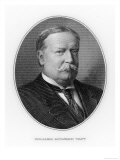
William Howard Taft
b. 9-15-1857; Cincinnati, OH
d. 3-8-1930; Washington, D.C.
Taft is the only US president to serve on the Supreme Court, from 1921 till his death.
William Howard Taft quotes ~
• “Don't write so that you can be understood, write so that you can't be misunderstood.”
• “No tendency is quite so strong in human nature as the desire to lay down rules of conduct for other people.”
• more presidents posters
|
|
|
|
|
|
|
Charles Evans Hughes
b. 4-11-1862; Glens Fall, New York
d. 8-27-1948; Osterville, Massachusetts
Charles Evans Hughes appointed as an Associate Justice by President Taft in 1910, resigned to run for president against Woodrow Wilson in 1916, and was appointed Chief Justice by Herbert Hoover in 1930.
Hughes served as New York governor; his daughter Elizabeth was one of the first patients to be injected with insulin as a treatment for diabetes (1921-22) by Dr. Frederick Banting.
|
|
|
|
|
|
|
William O. Douglas
b. 10-16-1898; Maine Twp, Otter Tail Co., MN
d. 1-19-1980; Washington, DC
Willaim O. Douglas is the longest-serving justice in the history of the Supreme Court - 36 years and 209 days, 1939-1975. He was appointed by Franklin Delano Roosevelt.
Douglas, whose father died when he was six, was granted a scholarship and continued to work odd jobs in order to earn a college degree. He then taught high school for several years in order to attend law school.
Douglas was a friend to the environment: reportedly he hiked the entire 2,000 mile Appalachian Trail from Georgia to Maine, and wrote a dissenting opinion in the landmark environmental law case, Sierra Club v. Morton, 405 U.S. 727 (1972), Justice Douglas famously, and most colorfully argued that “inanimate objects” should have standing to sue in court.
William O. Douglas quotes ~
• “I worked among the very, very poor, the migrant laborers, the Chicanos and the I.W.W's who I saw being shot at by the police. I saw cruelty and hardness, and my impulse was to be a force in other developments in the law.”
• “The Constitution is not neutral. It was designed to take the government off the backs of the people....”
• “A people who extend civil liberties only to preferred groups start down the path either to dictatorship of the right or the left.”
|
|
|
|
|
|
|
Fred M. Vinson
b. 1-22-1890; Louisa, KY
d. 9-8-1953; Washington, DC
Fred M. Vinson, the thirteenth Chief Justice of the United States, was appointed by President Truman, serving 1946-1953. Vinson also served as Secretary of the Treasury, and was elected to the House of Representatives for 12 years.
|
|
|
|
John M. Harlan II
b. 5-20-1899; Chicago, IL
d. 12-29-1971; Washington, DC
Justice John Harlan I (1833-1911), who served on the Court 1877-till his death, was John M. Harlan IIs grandfather.
Harlan II, characterized as a member of the conservative wing of the Warren Court, advocated a limited role for the judiciary, remarking that the Supreme Court should not be considered “a general haven for reform movements”.
Justice John Harlan I (1833-1911), who served on the Court 1877-till his death, was John M. Harlan IIs grandfather.
John M. Harland II quote ~
• “[O]ne man's vulgarity is another's lyric.” ~ Banned Books
|
|
|
|
Chief Justice Earl Warren
b. 3-19-1891; Los Angeles, CA
d. 7-9-1974; Washington, DC
Earl Warren quote ~
• “The fantastic advances in the field of electronic communication constitute a greater danger to the privacy of the individual.”
|
|
|
Hugo Black
b. 2-27-1886; Ashland, Alabama
d. 9-25-1971; Bethesda, MD
Politician and jurist Hugo LaFayette Black, who served as an Associate Justice of the Supreme Court of the United States from 1937 to 1971, is widely regarded as one of the most influential Supreme Court justices in the 20th century. Black was nominated to the Supreme Court by President Franklin D. Roosevelt.
|
|
|
|
|
|
|
|
|
|
|
|
|
William Rehnquist
b. 10-1-1924; Milwaukee, WI
d. 9-3-2005; Arlington, VA
William Rehnquist served as an Associate Justice on the Supreme Court of the United States and later as the Chief Justice of the United States (1972-2005). Rehnquist favored a conception of federalism that paid greater attention to the Tenth Amendment's reservation of powers to the states.
After Rehnquist death his dependency on Placidyl, a drug prescribed for insomnia, was revealed.
|
|
|
|
Sandra Day O’Connor
b. 3-26-1930; Texas
When President Ronald Reagan introduced Sandra Day O'Connor as the newest member of the United States Supreme Court, he called her “a person for all seasons” with ‘unique qualities of temperament [and] fairness.’ Those who knew Sandra Day O'Connor agreed that the President had made a wise choice.
Sandra Day grew up on a sprawling ranch on the Arizona-New Mexico border. She was a bit of a tomboy and loved riding horses and roping steers. She was also an excellent student, and she finished High school when she was only sixteen. She attended Stanford Law School and graduated near the top of her class. Amazingly, one of her fellow students was a young man named William Rehnquist, who would later serve with Justice O'Connor on the Supreme Court. After graduating from Stanford, she married John O'Connor and was elected to the Arizona State Senate. But when she was forced to choose between politics and the law, she chose the law, going to work as a judge.
When Justice Potter Stuart announced his retirement in 1981, President Reagan was determined to keep his campaign promise to appoint a woman to the Court. After a long search, the President chose Sandra Day O'Connor, saying, “She meets in every way the very high standards demanded of all Court appointees.” - text from a poster that is no longer avaiable
• Supreme Court Posters
• more Great American Women posters
• American Women composite poster
|
|
|
|
|
|
|
|
|
|
|
|
|
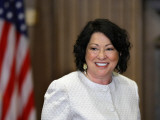
Sonia Sotomayor
b. 6-24-1954; The Bronx, NYC
Sonia Sotomayor is the Court's 111th justice, its first Hispanic justice, and its third female justice.
|
|
|
|
Elena Kagan
b. 4-28-1960; NYC
Elena Kagan is the Court's 112th justice and fourth female justice.
|
|
|
previous page | top
|
|
I have searched the web for visual, text, and manipulative curriculum support materials - teaching posters, art prints, maps, charts, calendars, books and educational toys featuring famous people, places and events - to help teachers optimize their valuable time and budget.
Browsing the subject areas at NetPosterWorks.com is a learning experience where educators can plan context rich environments while comparing prices, special discounts, framing options and shipping from educational resources.
Thank you for starting your search for inspirational, motivational, and educational posters and learning materials at NetPosterWorks.com. If you need help please contact us.
|
|
|