



Elie Wiesel Posters, Books, Video, Links for Learning
|
||||||||||||||||||||||||||||||
|
social studies > famous men > ELIE WIESEL POSTERS < literature |
||||||||||||||||||||||||||||||
|
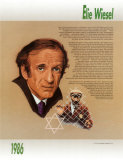
Elie Wiesel Elie Wiesel, writer, professor, and Holocaust survivor, was awarded the 1986 Nobel Peace Prize as “a messenger to mankind; his message is one of peace, atonement and human dignity. His belief that the forces fighting evil in the world can be victorious is a hard-won belief. His message is based on his own personal experience of total humiliation and of the utter contempt for humanity shown in Hitler's death camps. The message is in the form of a testimony, repeated and deepened through the works of a great author.”
|
||||||||||||||||||||||||||||||
• “There is divine beauty in learning, just as there is human beauty in tolerance. To learn means to accept the postulate that life did not begin at my birth. Others have been here before me, and I walk in their footsteps. The books I have read were composed by generations of fathers and sons, mothers and daughters, teachers and disciples. I am the sum total of their experiences, their quests. And so are you.” • ELIE WIESEL BOOKS, VIDEOAll Rivers Run to the Sea: Memoirs by Elie Wiesel - The long-awaited memoirs of Wiesel, winner of the 1986 Nobel Peace Prize, tell the story of his happy childhood in the Carpathian Mountains, his subsequent years of hell in Auschwitz and Buchenwald, and his post-war life in France, where he discovered his voice as a writer. Highly recommended. The Night Trilogy: Night, Dawn, The Accident by Elie Wiesel - Night is one of the masterpieces of Holocaust literature. Night, first published in 1960, it is the autobiographical account of an adolescent boy and his father in Auschwitz. Wiesel writes of their battle for survival, and of his battle with God for a way to understand the wanton cruelty he witnesses each day. In the short novel Dawn a young man who has survived the Second World War and settled in Palestine, is apprenticed to a Jewish terrorist gang. Commanded to execute a British officer who has been taken hostage, the former victim becoms an executioner. In The Accident, Wiesel again turns to fiction to question the limits of the spirit and the self. Can Holocaust survivors forge a new life without the memories of the old? As the author writes in his introduction, “In Night it is the ‘I’ who speaks; in the other two [narratives], it is the ‘I’ who listens and questions.” [from the back cover] A Vanished World by Roman Vishniac, Elie Wiesel - Roman Vishniac’s A Vanished World is an extraordinary record of the lives of German and Eastern European Jews in the years immediately preceding the Holocaust. Vishniac, a Russian Jew, began to take photographs of village life during World War I, when Russian Jews who lived near the front were accused of being German spies and were deported to Siberia. He later moved to Germany, where he witnessed the horrible events of Kristallnacht and the anti-Jewish legislation that allowed Hitler to declare his enemies stateless and therefore unworthy of international protection. As we study Vishniac’s photographs--a surviving fraction of the more than 16,000 he took--we are aware that we are seeing the faces of those soon to die, witnessing a world that has all but perished. Yet that world, of shops and schools, of busy streets and quiet farms, remains with us if only as a ghostly memory, thanks in part to Vishniac’s compassionate eye. Elie Wiesel Goes Home VHS ~ William Hurt - Greatness and Passion, The Story of David VHS - After a successful television debut, Great Figures of the Bible the special series narrated by Nobel Peace Prize winner Elie Wiesel, author of more than thirty books that have been translated into 18 different languages, has been adapted into a six-part videotape series. While Mr. Wiesel often appeared on television interviews and in news reports covering events such as his receipt of the Presidential Medal of Freedom at the White House to his humanitarian journey to Sarajevo, he had never before been the host of a television/video. Yale Roe, the producer of this series, designed the programs to open the richness and the relevance of the great Rabbinic stories to both the Jewish and non-Jewish viewer. Mr. Roe, a former ABC-TV network executive and now president of Yale Roe Films, is the author of two books on the television industry and is winner of numerous awards for his productions. LINKS FOR LEARNING : ELIE WIESEL |
||||||||||||||||||||||||||||||

|
|
|
|
|
NPW home | Global PathMarker Collection | APWTW Blog | faqs-about | contact | search | privacy |
|
NetPosterWorks.com ©2007-2015 The Creative Process, LLC All Rights Reserved. |
last updated