|
|
|
World Religions -
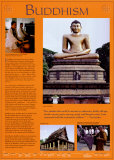
Buddhism Wall Poster
“For whether the world is eternal or otherwise, birth, old age, death, sorrow, pain, misery, grief, and despair exist. I am concerned with the extinction of these.” The Buddha
Buddhism developed from the teachings of Siddhartha Gautama, a Hindu prince from northern India who lived from 563 to 483 B.C. Siddhartha came to be known as the Buddha, or “the enlightened one.” One of the central beliefs of Buddhism is that suffering always exists in the world. The Buddha taught that the only way to avoid suffering is to understand it and its source – desire. Today about 350 million Buddhists live all around the world. Most Buddhist live in the Asian nations of Japan, China, and Vietnam, but many live in the U.S.
As a young prince, Siddhartha enjoyed a life of luxury in his father's palace. But he grew curious about the world outside the palace walls. When he left the palace, he discovered a world filled with suffering. He thought he might find freedom from suffering by giving up the material comforts of life. He soon realized that self-denial was no more helpful to him in his quest than the luxury of the palace was. So, Siddhartha shifted his lifestyle to the “middle path” – he tried to live a life of neither self-denial nor excess. Doing so helped him to concentrate and understand the world around him. Finally, he gained enlightenment, or complete understanding.
Buddhists strive to follow the Four Noble Truths that the Buddha discovered upon gaining enlightenment: 1) life involves suffering; 2) suffering comes from the desire for things to be as we want them to be; 3) the only way out of suffering is to abandon this desire; 4) only a life of morality, concentration, and wisdom can lead to the end of desire and suffering. Nirvana, or release from desire and suffering and from the cycle of life, death, and rebirth, is the supreme goal of Buddhism.
Like Hindus, Buddhists believe in reincarnation, or rebirth, and karma, the consequences of human actions. But unlike most other religions, Buddhism has no God or gods. Buddhists do not think of the Buddha as God, but as a man who achieved the ultimate spiritual life and gained understanding of the world.
• more Buddhism posters
|
|
|
|
Christianity,
Poster
no longer available
|
World Religions -
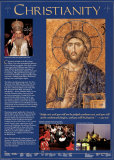
Christianity Wall Poster
“Judge not, and you will not be judged; condemn not and you will not be condemned; forgive, and you will be forgiven.”
Luke 6:37
Christianity is based on the life of Jesus Christ, a Jew who encourage his followers to love God and one another. Jesus lived in what is now Israel about 2,000 years ago. There are many different denominations, or groups, of Christians, but all Christians celebrate Jesus and his teaching. Although Christianity began as a scorned sect of Judaism, it spread rapidly. Today more than 1.9 billion people follow Christianity, making it the world's largest religion.
The Bible in the Christian holy book. The New Testament of the Bible describes Jesus' life and the experiences of some of the First Christians. Like Jews, Christians believe in the god of the Old Testament of the Bible. Christianity is monotheistic – that is, Christians believe in one God. But Christians believe Jesus was God on Earth in human form. During his life, some powerful leaders disliked Jesus, and he was executed as a criminal. According to the Bible, after Christ's death, he rose from the dead and appeared to his followers. He told then that those who had faith in him and followed God's teachings would be forgiven their sins and have everlasting life in Heaven.
Christianity spread rapidly after it became the official religion of the Roman Empire during the 4th century A.D. But centuries of debate over Christian beliefs and practices led the Eastern Orthodox Church to split from the Roman Catholic Church in 1054. Then, in 1517, a priest named Martin Luther rejected some of the practices of Catholicism. He said that Christians are saved through faith in Jesus rather than through effort or participation in the Church. Followers of Luther's belief extablished Protestantism in the religious movement called the Reformation.
• Christianity posters
• Vatican posters
|
|
|
|
Hinduism,
Poster
no longer available
|
World Religions -
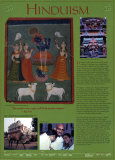
Hinduism Wall Poster
“The truth is one; sages call it by various names.” – Rig Veda
Hinduism is the oldest of the world's major religions. It developed as a combination of ancient Indian religions and the religion of the Aryans. The Aryans were nomads who invaded northern India between 2000 and 900 B.C. Hindus worship many different gods and goddesses, but these gods and goddesses are all part of Brahman, the absolute and supreme realty. Hindus believe that everything – all things and events – plays a role in universal order. Today, Hinduism is the majaor religion of India. More that 760 million Hindus live in India and around the world.
The Vedas – which means “body of knowledge” – are the most honored texts in Hinduism. the Upanishads [oo-PAHN-ih-shads], an important part of the Vedas, explain the concept of Brahamn. The Upanishads also discuss reincarnation, the belief that when a person dies, his or her soul is reborn in another living being. Hindus compare the soul to a river. Like a river, the soul flows continuously, but it is always the same. Other Hindu holy texts tell the stories of gods and goddesses. The three most important Hindu gods are Brahma, the creator; Vishnu, the preserver, and Siva, the destroyer. Individual devotion to a personal god is a major part of modern Hindu worship.
The Vedas also set up a “caste system,” a formal division of people into different social classes. Hindus believe that good actions in one life can lead to rebirth in a higher caste in the next life. A person's caste is determined by karma, the consequences of human actions. During the 1800s people started to work against the caste system because it denied basic rights to many. Under the caste system, “Untouchables,” people of the lowest social class, had to perform the worst jobs and couldn't use such public facilities as roads and wells. One man who led the struggle to end this system was the Hindu religious and political leader Mohandas K. Gandhi. Gandhi also helped India gain independence from Great Britain in 1947.
• Ancient India poster
• more Hinduism posters
|
|
|
|
World Religions -
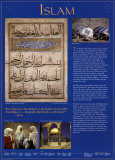
Islam Wall Poster
“Know that every True Believer is the brother of every other True Believer. ...Remember that Faith is in the heart.” Qur'an
The Arabic word “Islam” means peace, purity, acceptance and commitment. People who follow the Islamic religion are called Muslims. Islam in monotheistic that is, Muslims believe there is only one God. They believe Muhammad is the final and most important prophet, or messenger, of God, who is called Allah. But Muslims do not think of Muhammad as God. Muhammad lived from 570 to 632. He established Islam in Mecca, Saudi Arabia. His followers spread Islam from Mecca throughout the Arab world and beyond. The early Muslims converted people who lived in the lands the controlled in Arabia, North Africa, and Spain. Today, Islam is the world's second-largest religion – more than one billion Muslims live in the Middle East and around the world.
Muslims believe that Muhammad received the Qur'an [kuh-RAN], the Islamic holy book, from Allah. The Qur'an defines Islamic religious belief and practice. Overall, Islam teaches that a moral life can be led through complete submission to the will of Allah. In many Islamic nations, Islam is the state religion. In these countries, the law of Islam is the law of the land.
The Qur'an lists five duties that all Muslims must fulfill – these are known as the Five Pillars of Faith. Performing these duties makes up much of the day-to-day religious practice of Muslims. The first duty is shahadah, or testimony that "There is no god but Allah, and Muhammad is his prophet!" The next is salah, or prayer. Devout Muslim pray five times daily. The third duty is zakah, the giving of alms, or charity, to the poor. The fourth duty is sawm, or fasting. Muslims fast during the month of Ramadan, the time when Muhammad received the Qur'an. The final duty is hajj, or pilgrimage. If they are able, Muslims must visit the holy city of Mecca at least once in their lives.
• Islam posters
• Malcolm X posters
• Muhammad Ali posters
|
|
|
|
World Religions -
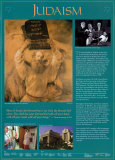
Judaism Wall Poster
“Here, O Lord, the Eternal One is our God, the Eternal God alone, You shall love your Eternal God with all your heart, and with all your mind, with all your being.” Deuteronomy 6:4-6
The central belief of Judaism is that there is one God for all humanity. The ancient Jews were the first to develop this concept, which is called monotheism. Jews believe that Judaism began 4,000 years ago when God made a covenant, or agreement, with Abraham and his people and bring then into a land of their own. Today, there are about eighteen million Jews in the world, many of whom live in the the U.S. The traditional Jewish homeland, Israel, was made an independent nation in 1948.
Abraham's covenant with God described in the Torah, the first five books of the Hebrew Bible. Christians call the Hebrew Bible the Old Testament. The Torah tells the story of the early Jews and establishes rules for how Jews should live. The most famous of these rules are the Ten Commandments. Jews believe that Moses, a Jewish religious leader who lived during the 12th century B.C., received the Ten Commandments and the rest of the Torah directly from God.
Throughout their history, Jews have endured persecution. In 586 B.C., the Jewish temple in Jerusalem was destroyed by the Babylonians, and many Jews were exiled from their homeland. During the Middle Ages and the Renaissance, European Jews face anti-Semitism – prejudice against people of the Jewish faith – from the predominantly Christian European population. And during World War II, more than six million Jews were murdered by Adolf Hitler and the Nazis in the Holocaust.
Jews worship God in temples called synagogues. Jews celebrate several holidays throughout the year, including Passover, which commemorates Moses leading the Israelites from bondage; Rosh Hashanah, the Jewish New Year, and Yom Kippur, the most sacred day of the Jewish calendar.
|
|
|
social studies > theology 1 | 2 | WORLD'S RELIGIONS SERIES < theologians < peace
previous page | top
|
|
I have searched the web for visual, text, and manipulative curriculum support materials - teaching posters, art prints, maps, charts, calendars, books and educational toys featuring famous people, places and events - to help teachers optimize their valuable time and budget.
Browsing the subject areas at NetPosterWorks.com is a learning experience where educators can plan context rich environments while comparing prices, special discounts, framing options and shipping from educational resources.
Thank you for starting your search for inspirational, motivational, and educational posters and learning materials at NetPosterWorks.com. If you need help please contact us.
|
|
|