|
Stephane Mallarme
b. 3-18-1842; Paris, France
d. 9-9-1898
Mallarme was a poet and critic who is also noted for his Tuesday night salon where intellectuals such as Yeats, Rilke, Valéry, and Verlaine, met at his house to discuss poetry, art, and philosophy. Mallarme also translated Edgar Allan Poe's “The Raven”, that was illustrated by Manet.
Stephane Mallarme quotes ~
• “Dreams have as much influence as actions.”
• “The poetic act consists of suddenly seeing that an idea splits up into a number of equal motifs and of grouping them; they rhyme.”
• Selected Poetry & Prose by Stephane Mallarme
|
|
|
|
Sir Thomas Malory
b. c. 1405; England
d. 3-14-1471
“Le Morte d'Arthur”, based on the Arthurian legend of the Middle Ages, was compiled from French and English romances by Thomas Malory between the 1450s and 1470. The book was printed by William Caxton, the first English person to work as a printer and who introduced the printing press into England.
Le Morte d'Arthur has stirred readers everywhere ... but not positively in Kentucky, when it was banned in 1987.
Sir Thomas Malory quotes ~
• “The month of May was come, when every lusty heart beginneth to blossom, and to bring forth fruit.”
• “Whoso pulleth out this sword of this stone and anvil is rightwise king born of all England.”
|
|
|
|
Andre Malraux
b. 11-3-1901; Paris, France
d. 11-23-1976
Andre Malraux wrote about his adventures in Indochina (southwest Asia), the Republican forces in the Spanish Civil War (1936-39), the French Resistence in WWII, politics and culture.
Andre Malraux quotes ~
• “All art is a revolt against man's fate.”
• “And when man faces destiny, destiny ends and man comes into his own.”
• “Genius is not perfected, it is deepened. It does not so much interpret the world as fertilize itself with it.”
• “To command is to serve, nothing more and nothing less.”
• “War puts its questions stupidly, peace mysteriously.”
|
|
|
|
Thomas Mann
b. 6-6-1875; Lubeck, Germany
d. 8-23-1955; Zurich, Switzerland
Thomas Mann was a novelist, short story writer, social critic, philanthropist, and essayist. He was awarded the 1929 Nobel Prize in Literature, “principally for his great novel, Buddenbrooks (1901), which has won steadily increased recognition as one of the classic works of contemporary literature”. Buddenbrooks describes the progress of tuberculosis, also known as consumption
Mann's work is highly symbolic and noted revealing the psychology of the artist and the intellectual as well as revealing the European and German psyche through paraphrasing German and Biblical stories and the ideas of Goethe, Nietzsche, and Schopenhauer. His novel Dr. Faustus has a song cycle inspired by the poet Clemens Brentano.
FYI - the song “Is That All There Is?” written by Jerry Leiber and Mike Stoller, and recorded in 1969 by Peggy Lee, was inspired by Thomas Mann's short story “Disillusionment”.
Thomas Mann quotes ~
• “A writer is somebody for whom writing is more difficult than it is for other people.”
• “An art whose medium is language will always show a high degree of critical creativeness, for speech is itself a critique of life: it names, it characterizes, it passes judgment, in that it creates.”
• “A man lives not only his personal life, as an individual, but also, consciously or unconsciously, the life of his epoch and his contemporaries.”
• “A solitary, unused to speaking of what he sees and feels, has mental experiences which are at once more intense and less articulate than those of a gregarious man. ”
• “Culture and possessions, there is the bourgeoisie for you.”
• “For the myth is the foundation of life; it is the timeless schema, the pious formula into which life flows when it reproduces its traits out of the unconscious.”
• “Human reason needs only to will more strongly than fate, and she is fate.”
• “One must die to life in order to be utterly a creator.”
• “War is only a cowardly escape from the problems of peace.”
• The Cambridge Companion to Thomas Mann
• Buddenbrooks book cover poster
|
|
|
|
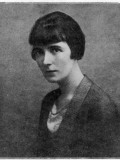
Katharine Mansfield
née Katharine Mansfield Beauchamp
b. 10-14-1888; Wellington, New Zealand
d. 1-9-1923; Fontainebleau, France (tuberculosis)
Katharine Mansfield, a modernist short story writer, is also remembered for her friendships and influence with D. H. Lawrence and Virginia Woolf.
Katherine Mansfield quotes ~
• “Would you not like to try all sorts of lives — one is so very small — but that is the satisfaction of writing — one can impersonate so many people.”
• “I have made it a rule of my life never to regret and never to look back. Regret is an appalling waste of energy, and no one who intends to become a writer can afford to indulge in it.”
• “Everything in life that we really accept undergoes a change. So suffering must become Love. This is the mystery. This is what I must do.”
• “By health I mean the power to live a full, adult, living, breathing life in close contact with what I love — the earth and the wonders thereof — the sea — the sun.”
• “Risk! Risk anything! Care no more for the opinion of others, for those voices. Do the hardest thing on earth for you. Act for yourself. Face the truth.”
• “I want, by understanding myself, to understand others. I want to be all that I am capable of becoming so that I may be (and here I have stopped and waited and waited and it’s no good — there’s only one phrase that will do) a child of the sun.”
• “Could we change our attitude, we should not only see life differently, but life itself would come to be different. Life would undergo a change of appearance because we ourselves had undergone a change of attitude.”
• “The world to me is a dream and the people in it are sleepers. I have known a few instances of intensity but that is all. I want to find a world in which these instances are united.”
• “It is of immense importance to learn to laugh at ourselves.”
|
|
|
|
Alessandro Manzoni
b. 3-7-1785; Milan, Italy
d. 5-22-1873
Poet and novelist Alessandro Manzoni is noted for his The Betrothed, considered on the major works of Italian literature.
Alessandro Manzoni quotes ~
• “It is one of the advantages of this world that people can hate and be hated without knowing each other.”
• “The general practice is for the secret to be confided only to an equally trustworthy friend, the same conditions being imposed on him. And so from trustworthy friend to trustworthy friend the secret goes moving on round that immense chain, until finally it reaches the ears of just the very person or persons whom the first talker had expressly intended it never should reach.”
• “A lawyer must be told things frankly; then it's up to us to muddle them up.”
|
|
|