|
|
|
|
|
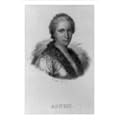
Maria Gaetana Agnesi
b. 5-16-1718; Milan, Italy
d. 1-9-1799
Maria Gaetana Agnesi was a child prodigy recognized as a mathematician, and philosopher, and linguist. She is credited with writing the first book discussing both differential and integral calculus and was an honorary member of the faculty at the University of Bologna.
Agnesi can also be considered an activist for her composing and delivering a speech in Latin on a woman's right to education at the age of nine.
A crater on Venus is named in her honor.
|
|
|
|
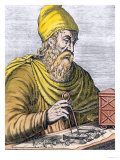
Archimedes
b. 287 BC, Syracuse, Sicily
d. 212 BC, Syracuse, Sicily
Mathematician, physicist, engineer, astronomer and philosopher Archimedes of Syracuse, is considered the greatest inventor of ancient times. He made important discoveries in geometry, hydrostatics, and mechanics, formulating the principle of buoyancy and of the lever. Much of his work and results were not surpassed for over 1,500 years.
Archimedes quotes
• “I have found it!”
• “Give me the place to stand, and I shall move the earth.”
• “Do not disturb my circles!”
• The Archimedes Codex: How a Medieval Prayer Book Is Revealing the True Genius of Antiquity's Greatest Scientist
|
|
|
|
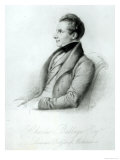
Charles Babbage
b. 12-26-1791/2; London, England
d. 10-18-1871
Charles Babbage, frustrated by the tediousness of calculation and the high rate of human error, originated the idea of a programmable computer to mechanically calculate mathematical tables.
Charles Babbage quotes ~
• “The whole of arithmetic now appeared within the grasp of mechanism.”
• “If we look at the fact, we shall find that the great inventions of the age are not, with us at least, always produced in universities.”
|
|
|
|
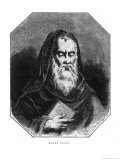
Roger Bacon, aka Doctor Mirabilis (wonderful teacher)
b. 1214; Ilchester, Somerset, England
d. 1294; Oxford
Roger Bacon was a medieval Franciscan friar, teacher, and philosopher who wrote on alchemy, mathematics, optics, astronomy, astrology and theology. He is recognized as one of the earliest European advocates of the modern scientific method.
Roger Bacon quotes ~
• “For the things of this world cannot be made known without a knowledge of mathematics.”
• “The strongest arguments prove nothing so long as the conclusions are not verified by experience. Experimental science is the queen of sciences and the goal of all speculation.”
• The Opus Majus of Roger Bacon: Edited, with Introduction and Analytical Table, by John Henry Bridges. Volume 1 (Paperback)
|
|
|
|
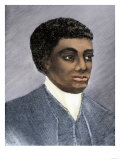
Benjamin Banneker
b. 11-9-1731; Baltimore Co., MD
d. 10-9-1806
Benjamin Banneker, called the Sable Astonomer, was a self motivated learner whose basic reading, writing and mathematics skills came from home schoolng and a Quaker school. He complied the ephemeris (information table) for annual almanacs published 1792 through 1797, predicting solar and lunar eclipses, and provided assistance in the planning of the Federal District, which is now Washington, D.C., by making sure the astronomical clock was keeping accurate time.
• more Benjamin Banneker curriculum resources
|
|
|
|
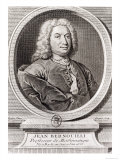
Johann Bernoulli (also known as John or Jean)
b. 7-27-1667; Basel, Switzerland
d. 1-1-1748; Basel
The Bernoulli's were a mathematically brilliant family. John (also known as Johann or Jean), the father, was a mathematician and educator (Euler was his student), and who, along with his brother Jakob (Bernoulli numbers), were among the first to understand the new calculus (introduced as students of Leibniz) and to apply calculus to problems.
John was also the father of mathematician Daniel Bernoulli (1700-1782) who is remembered for his principle of fluid mechanics stating that “as the speed of a moving fluid increases, the pressure within the fluid decreases” - or why an airplane wing is shaped the way it is.
|
|
|
|
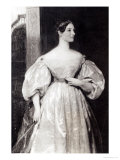
Augusta Ada Byron, Countess of Lovelace
b. 12-10-1815; London, England
d. 11-27-1852
Ada Lovelace was the only legitimate daughter of Lord Byron. She received early training as a mathematician and is considered to have written the first computer program in her correspondence with Charles Babbage about his early mechanical general-purpose computer, the analytical engine.
• Ada, Countess of Lovelace
|
|
|
|
|
|
|
|
previous page | top | next
mathematics | mathematicians list | A-B | c | d | e | f-g | h-k | l-m | n | o-p-q | r-s | t-z < numbers
|
|
I have searched the web for visual, text, and manipulative curriculum support materials - teaching posters, art prints, maps, charts, calendars, books and educational toys featuring famous people, places and events - to help teachers optimize their valuable time and budget.
Browsing the subject areas at NetPosterWorks.com is a learning experience where educators can plan context rich environments while comparing prices, special discounts, framing options and shipping from educational resources.
Thank you for starting your search for inspirational, motivational, and educational posters and learning materials at NetPosterWorks.com. If you need help please contact us.
|
|
|