|
|
|
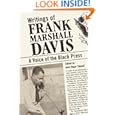
Frank Marshall Davis
b. 12-31-1905; Arkansas City, KS
d. 7-28-1987; Honolulu, HI
Frank Marshall Davis, a central figure in the black press, worked as a reporter and editor for the Atlanta World, the Associated Negro Press, the Chicago Star, and the Honolulu Record.
|
|
|
|
Lucy Delaney
b. c. 1830; St. Louis, MO
d. after 1891
African American author, former slave, and activist Lucy Delaney is remembered for her 1891 narrative From the Darkness Cometh the Light, or, Struggles for Freedom, the only first-person account of a “freedom suit”.
Freedom suits were legal petitions filed by slaves in the United States and its territories before the American Civil War, including during the colonial period. Delaney's was one of the few post-Emancipation published slave narratives.
FYI ~ Marguerite Scypion, an African-Natchez woman born into slavery in Saint Louis, Missouri Territory, filed the first “freedom suit” in the St. Louis circuit court, in 1805, 41 years before Dred Scott and his wife Harriet filed their more well-known case.
Elizabeth Key Grinstead was the first woman of African ancestry in the North American colonies to sue for her freedom and win, on July 21, 1656. Her mother was a black slave, her father a white English planter named Thomas Key. She eventually was able to marry William Grinstead, a young English lawyer who had arrived in the colonies as an indentured servant, because of not being his father's first born son. In 1907 their descendant James Fauntleroy Grinstead was elected Mayor of Louisville, Kentucky.
Charlotte Dupuy filed a freedom suit in 1829 against her master Henry Clay who was then Secretary of State.
|
|
|
|
Martin Delany
b. 5-6-1812; Charles Town, WV
d. 1-24-1885; Xenia, OH (tuberculosis)
Martin Delany, born free, learned to read and write as a child, and continued his education, both formally and informally, his entire life. He was admitted to the Harvard Medical School, though he and two other black students were dismissed because of complaints from white students (1850).
Delany worked with Frederick Douglass on The North Star and was an early proponent of emigration to Africa as a new start for freed slaves.
Delaney was the first African American field officer in the United States Army during the Civil War, serving as a surgeon in the Fifty-fourth Massachusetts Volunteer Infantry.
|
|
|
|
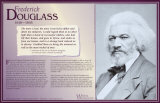
Frederick Douglass
b. 2-14-c.1818; Maryland
d. 2-20-1895
Poster Text: “The more I read, the more I was lead to abhor and detest my enslavers. I could regard them in no other light than a band of successful robbers, who had left their homes, and gone to Africa, and stolen us from our homes, and in a strange land reduced us to slavery. I loathed them as being the meanest as well as the most wicked of men.”- Narrative of the Life of Frederick Douglass
Frederick Augustus Washington Bailey was born into slavery in rural Maryland – he never knew exactly when he was born. As a child, he wore nothing but a shirt, ate little but mush, and lived in fear of the brutal beatings that were common on the plantation. When he was 7 or 8 years old, he was sent to Baltimore to serve as a houseboy for the Auld family. Mrs. Sophia Auld taught “Freddy” the alphabet and some simple words before her husband ordered her to stop. But Freddy did not stop, and he learned how to read by tricking some white servants into helping him. By the time he was went back to work in the fields, he had made up his mind to be free. He held on to this feeling through several years of horrible treatment as a field slave. He finally escaped in 1838 and made his way north to New Bedford, Massachusetts, where he took the name “Frederick Douglass.”
An anti-slavery group invited Douglass to talk to them. He soon became known as a powerful speaker and a leader of the abolitionist movement. His autobiography, Narrative of the Life of Frederick Douglass, An American Slave, Written by Himself, was published in 1845. The book was very popular because Douglass wrote about the evils of slavery in his own truthful words.
After Narrative of the Life of Frederick Douglass was published, Douglass was the best-known and most respected African American leader in the nation. He founded a magazine, published two more works of autobiography, and helped recruit African American troops during the Civil War. After the Civil War, Douglass served as Minister to Haiti and as the Marshal for the District of Columbia. He died in 1895.
• more Frederick Douglass posters
• more Writers Who Changed the World posters
|
|
|
|
Rita Dove
b. 8-28-1952; Akron, OH
Rita Dove was 1987 Pulitzer Prize winner for poetry and Poet Laureate of the United States.
Dove's poetry is lyrical, musical - listen to her read her American Smooth at the Geraldine R. Dodge Poetry Festival. American Smooth is a type of ballroom dance, - listen to the flow and rhythm.
Rita Dove quotes ~
• “If we’re going to solve the problems of the world, we have to learn how to talk to one another. Poetry is the language at its essence. It’s the bones and the skeleton of the language. It teaches you, if nothing else, how to choose your words.”
• “Poetry is language at its most distilled and most powerful.”
• “If our children are unable to voice what they mean, no one will know how they feel. If they can’t imagine a different world, they are stumbling through a darkness made all the more sinister by its lack of reference points. For a young person growing up in America’s alienated neighborhoods, there can be no greater empowerment than to dare to speak from the heart — and then to discover that one is not alone in ones feelings.”
• Rita Dove Books
|
|
|
|
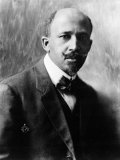
W. E. B. DuBois
b. 2-23-1868; Great Barrinton, MA
d. 8-27-1963
“The problem of the twentieth century is the problem of the color line.”
A noted scholar, writer, educator, and activist, W. E. B. Dubois devoted his life to studying and addressing the social and economic condition of black people. He was admired by his contemporaries for fighting injustice and defending freedom.
• more W. E. B. DuBois
|
|
|
|
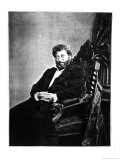
Alexandre Dumas père
b. 7-24-1802; France
d. 12-5-1870
Alexander Dumas, père (which means father) is best known for his numerous historical novels of high adventure such as The Count of Monte Cristo and The Three Musketeers. Dumas had a collaborator, Auguste Maquet, whose contribution of plot outline and character drafts were not acknowledgd publicly but were paid for with generous fees. The elder Alexandre Dumas' reworking of E.T.A. Hoffmann's “The Nutcracker and the Mouse King” was used by Pyotr Ilyich Tchaikovsky as the basis for his ballet, “The Nutcracker”.
Dumas was the grandson of a French military officer and an Afro-Caribeean Creole, and the son of an improvished military officer who had gotten on the wrong side of Napolean.
Alexandre Dumas, père quotes ~
• “All for one, one for all.”
• “Business, that's easily defined; it's other people's money.”
• “Friendship consists in forgetting what one gives, and remembering what one receives.”
• “Men's minds are raised to the level of the women with whom they associate.”
• “It is neccessary to have wished for death in order to know how good it is to live.”
• “How is it that little children are so intelligent and men so stupid? It must be education that does it.”
• “One's work may be finished some day, but one's education never.”
• “I prefer rogues to imbeciles, because they sometimes take a rest.”
• “The custom and fashion of today will be the awkwardness and outrage of tomorrow - so arbitrary are these transient laws.”
• Alexandre Dumas, fils
|
|
|
|
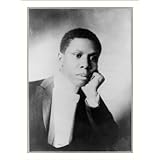
Paul Laurence Dunbar
b. 6-27-1872; Dayton, OH
d. 2-9-1906
Paul Laurence Dunbar, the son of former slaves, was one of the most prominent figures in American literature at the turn of the twentieth century. Dunbar had published four novels, four collections of short stories, and fourteen books of poetry, as well as numerous songs, plays, and essays in newspapers and magazines around the world when he passed at the age of thirty-three in 1906. (based on book information from The Complete Stories of Paul Laurence Dunbar)
Paul Laurence Dunbar ~
• “I know why the caged bird sings, ah me, when his wing is bruised and his bosom sore; when he beats his bars and he would be free, it is not a carol of joy or glee, but a prayer that he sends from his heart's deep core.”
• “People are taking it for granted that [the Negro] ought not to work with his head. And it is so easy for these people among whom we are living to believe this; it flatters and satisfies their self-complacency.”
• “In Dahomey”
|
|
previous page | top | next
black history > Black Writers Index > a-c | D | e-g | h-i | j-n | o-t | w-x
|
|
I have searched the web for visual, text, and manipulative curriculum support materials - teaching posters, art prints, maps, charts, calendars, books and educational toys featuring famous people, places and events - to help teachers optimize their valuable time and budget.
Browsing the subject areas at NetPosterWorks.com is a learning experience where educators can plan context rich environments while comparing prices, special discounts, framing options and shipping from educational resources.
Thank you for starting your search for inspirational, motivational, and educational posters and learning materials at NetPosterWorks.com. If you need help please contact us.
|
|
|