|
|
Perspective Posters
instructional, motivational and inspirational images for the classroom, home schoolers, office.
|
art > PERSPECTIVE | optical illusion posters < art education resources
|
|
PERSPECTIVE: Aerial and linear perspectives are techniques used to create the illusion of three dimensional space or object (height, width and depth) on a two dimensional surface as illustrated in the photograph of railroad tracks.
Intellectually we understand that the tracks were designed to support the train with fixed width distance between the wheels for the entire journey and the road will not get narrower; the graphic clue that part of the track is further away is due to our eyes perceiving distant objects as smaller, shorter, skinnier, and less distinct.
Six basic perspective concepts are • one-point, • two-point, • three-point, • multi-point, • circles and cylinders, • atmospheric perspective.
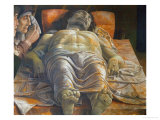
Foreshortening is the method of creating an impression of three-dimensional volume on a two dimensional surface as illustrated by Mantengna famous painting of Christ.
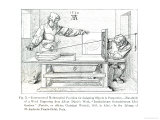
Suggested images for teaching perspective, optical illusion, and integrating cross discipline art instruction with history and science include the School of Athens by Raphael, the Albrecht Dürer apparatus for “seeing” perspective, the mastery of M. C. Escher to manipulate space, the “op art” of Vasarely and Riley, and photographic examples emphasizing perspective lines.
“The one point, linear perspective is an intellectual, rationalistc, and above all purely mechanistic way of dividing space, a development sychronous with Gutenburg's press.” Jose Arguelles, The Transformative Vision.
|
|
|
Giotto di Bondone
b. c. 1267; Italy
d. 1-8-1337
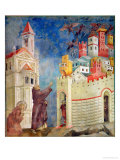
Giotto di Bondone, known simply as Giotto, was both an architect and painter. Born near Florence in the late Middle Ages, he was, according to Vasari, the first to make “a decisive break with . . . the Byzantine style, and brought to life the great art of painting ... drawing accurately from life.” The frescos at Arezzo depict the life of St. Francis; in the pictured fresco Giotto's figures are grounded in a medieval cityscape depicted with what is referred to as pseudoperspective.
• Giotto (Getting to Know the World's Greatest Artists)
|
|
|
|
Filippo Brunelleschi
b. c. 1377; Italy
d. 4-15-1446
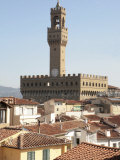
Filippo Brunelleschi, an Italian Renaissance architect and sculptor, is credited with the first known paintings using geometric optical linear perspective. The paintings, now lost, were of the Florentine Bapistery and the Palazzo Vecchio. They were designed to be viewed as a reflection with the aid of a mirror through a hole located at the vanishing point from the backside, in order to demonstrate the Euclidian laws of geometric optics.
• Brunelleschi: Studies of His Technology and Inventions
|
|
|
|
Piero della Francesca
b. c. 1415; Sansepolcro, Republic of Florence, Italy
d. 10-12-1492; Sansepolcro
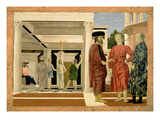
Early Renaissance mathematician and geometer Piero della Francesca is best remembered today for his paintings which used geometric shapes and perspective.
Among his works are three notable treatises: Abacus Treatise, Short Book on the Five Regular Solids and On Perspective for Painting.
• Piero della Francesca
|
|
|
|
Albrecht Dürer
b. 5-21-1471; Nuremberg, Germany
d. 4-6-1528
Albrecht Dürer is an early Renaissance artist best known today for his prints from woodcuts and copper engraving.
The Renaissance ideal of the complete man - the artist as scholar and gentleman - appealed to Dürer who had begun his lifelong search for new ideas, theories, and techniques, and for the solution to the problem of combining realism with abstract concepts.
During his later years he devoted considerable time to writing and illustrating a book on theories of art based on Piero della Francesca's earlier work with perspective.
• “I hold that the perfection of form and beauty is contained in the sum of all men.”
• more Albrecht Durer posters
|
|
|
|
Raphael
b. 4-6-1483; Italy
d. 4-6-1520
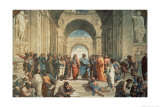
Italian Renaissance artist Raphael created the illusion of depth in a grand interior architectural space in the fresco “School of Athens”. Raphael constructed mathematical linear one point perspective, and used size, light, shadow, and overlapping figures in his imaginary portraits of the greatest ancient philosophers (Plato and Aristotle are in the foreground center) in the rational pursuit of truth.
|
|
|
|
Sebastiano Serlio
b. 9-6-1475; Italy
d. c. 1554
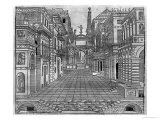
Sebastiano Serlio was a Mannerist style architect and stage set designer who published several books of woodcut designs for stage setting, Scenographies, in Paris (1545), as a part of his treatise devoted to perspective.
• Perspective Rendering for the Theatre
|
|
|
|
Giacomo Barozzi da Vignola
b. 10-1-1507; Italy
d. 7-7-1573; Rome
Giacomo Barozzi da Vignola, or simply Vignola, was a Mannerist style architect.
|
|
|
|
Giovanni Antonio Canal
b. 10-28-1697; Venice
d. 4-19-1768
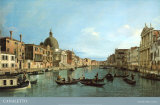
Giovanni Antonio Canal, known as Canaletto, was the 18th century’s most famous view-painter. He was aided by the camera obscura, an early version of modern cameras.
|
|
|
|
William Hogarth
b. 11-10-1697; London
d. 10-26-1764
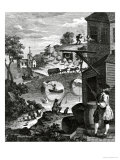
Hogarth's engraving Satire on False Perspective (1754) is captioned “Whoever makes a DESIGN without the Knowledge of PERSPECTIVE will be liable to such Absurdities as are shewn in this Frontipiece.” For instance - in the upper right corner, the woman leaning out the window with a candle is lighting the pipe of the man on the distant hill.
|
|
|
|
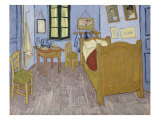
Vincent van Gogh, not known for his use of linear perspective, has employed the technique in an attempt to establish an orderly world.
|
|
|
|
|
|
|
Salvador Dali
b. 5-11-1904; Spain
d. 1-23-1989; Spain
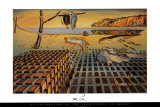
Dali used perspective to create the illusion of a rational landscape, and then “melted” familiar objects so they appeared as lifeless skins.
|
|
|
|
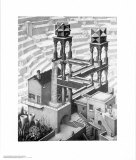
The Dutch artist M. C. Escher gives viewers a reality check by manipulating linear perspective and expected proportions to create a visual paradox of water seemingly flowing upward in order to fall onto the waterwheel.
|
|
|
|
|
|
|
|
|
|
The Power of Perspective
“It suddenly struck me that that tiny pea, pretty and blue, was the Earth. I put up my thumb and shut one eye, and my thumb blotted out the planet Earth. I didn't feel like a giant, I felt wery, very small.”
Neil Armstrong
|
|
|
previous page | top
|
|
I have searched the web for visual, text, and manipulative curriculum support materials - teaching posters, art prints, maps, charts, calendars, books and educational toys featuring famous people, places and events - to help teachers optimize their valuable time and budget.
Browsing the subject areas at NetPosterWorks.com is a learning experience where educators can plan context rich environments while comparing prices, special discounts, framing options and shipping from educational resources.
Thank you for starting your search for inspirational, motivational, and educational posters and learning materials at NetPosterWorks.com. If you need help please contact us.
|
|
|