|
|
|
|
|
|
|
|
|
|
|
|
|
|
SCIENCE:
PHYSICS & CHEMISTRY
|
|
|
|
|
|
|
|
|
|
|
|
|
|
|
|
|
|
|
 |
|
|
|
|
|
|
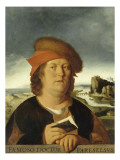
Paracelsus, nee Phillip von Hohenheim
b. 11-11-1493; near Einsiedeln, Old Swiss Confederacy
d. 9-24-1541; Salzburg, Austria - burned at the stake as a witch
Paracelsus, a medieval alchemist who offended everyone with his arrogance, was the name chosen by Phillip von Hohenheim later Philippus Theophrastus Aureolus Bombastus von Hohenheim as a title to mean ‘equal to or greater than Celsus.’ He was also a physician and astrologer.
Paracelsus quotes ~
• “Dreams are not without meaning wherever thay may come from - from fantasy, from the elements, or from other inspiration.”
• “Medicine is not only a science; it is also an art. It does not consist of compounding pills and plasters; it deals with the very processes of life, which must be understood before they may be guided.”
• “Poison is in everything, and no thing is without poison. The dosage makes it either a poison or a remedy.”
• “We do not know it because we are fooling away our time with outward and perishing things, and are asleep in regard to that which is real within ourself.”
• “Thoughts create a new heaven, a new firmament, a new source of energy, from which new arts flow.”
Fellow Swiss Carl Gustav Jung wrote about Paracelsus in “The Spirit in Man, Art and Literature.”
|
|
|
|
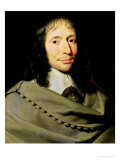
Blaise Pascal
b. 6-19-1623; Clermont-Ferrand, France
d. 8-18-1662; Paris
Pascal, a child prodigy educated by his father, was a mathematician, physicist, and religious philosopher whose earliest work was in the natural and applied sciences. Pascal made important contributions to the construction of mechanical calculators, study of fluids, clarified the concepts of pressure and vacuum by generalizing the work of Evangelista Torricelli, and corresponded with Fermat on the probability theory. Pascal wrote in defense of the scientific method, and after a mystical experience, abandoned his scientific studies.
Blaise Pascal quotes ~
“Fire. God of Abraham, God of Isaac, God of Jacob, not of the philosophers and the scholars. I will not forget thy word. Amen.”
“Contradiction is not a sign of falsity, nor the lack of contradiction a sign of truth.”
• Blaise Pascal: Thoughts, Letters, and Minor Works
|
|
|
|
|
|
|
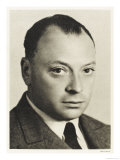
Wolfgang Ernst Pauli
b. 4-25-1900; Vienna
d. 12-15-1958; Zurich, Switzerland
Wolfgang Paui was awarded the 1945 Nobel Prize in Physics for “decisive contribution through his discovery in 1925 of a new law of Nature, the exclusion principle or Pauli principle,” (no two identical fermions may occupy the same quantum state simultaneously.
Pauli also consulted the psychiatrist and psychotherapist Carl Gustav Jung who interpreted Pauli's deeply archetypal dreams, documented in “Psychology and Alchemy”. Their letters are published as “Atom and Archetype”.
Wolfgang Pauli quotes ~
• “When that amusing ‘Pauli effect’ of the overturned vase occurred, on the occasion of the founding of the Jung Institute, I had the immediate and vivid impression that I should ‘pour out water inside’ (— to use the symbolic language that I have acquired from you). Then when the connection between psychology and physics took up a relatively large part of your talk, it became even more clear to me what I was to do.” - Letter to Jung, 6-16-1948
• “I have done a terrible thing, I have postulated a particle that cannot be detected.”
• Pauli and Jung: The Meeting of Two Great Minds
• Theory of Relativity, by Wolfgang Pauli
|
|
|
|
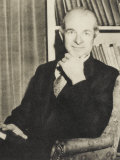
Linus Pauling
b. 2-28-1901; Portland, Oregon
d. 8-19-1994; Big Sur, CA
Linus Pauling was awarded the 1954 Nobel Prize in Chemistry and the 1962 Peace Prize, for advocating nuclear disarmament. In later life he became a nutrition advocate for greatly increased consumption of vitamin C and other nutrients.
Pauling is the only person to win two Nobel Prizes that were not shared. Others who were awarded two Nobel Prizes were Marie Curie, John Bardeen, and Frederick Sanger.
Linus Pauling quotes ~
• “Science cannot be stopped. Man will gather knowledge no matter what the consequences – and we cannot predict what they will be. Science will go on — whether we are pessimistic, or are optimistic, as I am. I know that great, interesting, and valuable discoveries can be made and will be made… But I know also that still more interesting discoveries will be made that I have not the imagination to describe — and I am awaiting them, full of curiosity and enthusiasm.”
• “The only sane policy for the world is that of abolishing war.”
• “If you want to have good ideas you must have many ideas. Most of them will be wrong, and what you have to learn is which ones to throw away.”
• “I have something that I call my Golden Rule. It goes something like this: "Do unto others twenty-five percent better than you expect them to do unto you." … The twenty-five percent is for error.”
• How to Live Longer and Feel Better (1986)
• General Chemistry
|
|
|
|
Roger Penrose
b. 8-8-1931; Colchester, England
Mathematical physicist and professor Roger Penrose has “written controversial books on the connection between fundamental physics and human (or animal) consciousness”.
Roger Penrose quotes ~
• “Understanding is, after all, what science is all about — and science is a great deal more than mindless computation.”
• “Children sometimes see things clearly that are obscured in later life. We often forget the wonder that we felt as children when the cares of the "real world" have begun to settle on our shoulders. Children are not afraid to pose basic questions that may embarrass us, as adults, to ask. What happens to each of our streams of consciousness after we die; where was it before we were born; might we become, or have been, someone else; why do we perceive at all; why are we here; why is there a universe here at all in which we can actually be? These are puzzles that tend to come with the awakenings of awareness in any one of us — and, no doubt, with the awakening of self-awareness, within whichever creature or other entity it first came. ”
|
|
|
|
Auguste Piccard
b. 1-28-1884; Basel, Switzerland
d. 3-24-1962; Lausanne
Auguste Piccard and his twin brother Jean-Felix were scientists involved in chemistry, engineering, exploring, and teaching. August set aviation altitude records with his pressurized gondola.
FYI ~ Gene Roddenberry named the captain of Star Trek's Enterprise Jean-Luc Picard on one or both of the Piccard brothers, though in the series Jean-Luc denies being a descendent of Jean-Felix.
|
|
|
|
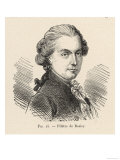
Jean-Francois Pilatre de Rozier
b. 3-30-1754; Metz, France
d. 6-15-1785
Jean-Francois Pilatre de Rozier, a chemistry and physics teacher, became, along with his flight companion Pierre Romain, the first known victims of an air crash, in their attempt to cross the English Channel.
“In France, a chemist named Pilatre de Rozier tested the flammability of hydrogen by gulping a mouthful and blowing across an open flame, proving at a stroke that hydrogen is indeed explosively combustible and that eyebrows are not necessarily a permanent feature of one's face.”
— Bill Bryson - A Short History of Nearly Everything
|
|
|
|
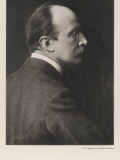
Max Planck
b. 4-23-1858; Kiel, Duchy of Holstein, Germany
d. 10-4-1947; Germany
Physicist Max Planck, considered to be the founder of the quantum theory, was awarded the Nobel Prize in Physics in 1918 “for the services he rendered to the advancement of Physics by his discovery of energy quanta.”
• Where Is Science Going?- Max Planck
|
|
|
|
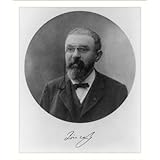
Henri Poincaré
b. 3-29-1854; Nancy, France
d. 7-17-1912; Paris
Mathematician, theoretical physicist, and philosopher of science Henri Poincare is often described as a polymath, excelling in all fields of the discipline as it existed during his lifetime.
The Poincaré group used in physics and mathematics was named after him. He was also a professor at the Sorbonne holding the chairs of Physical and Experimental Mechanics, Mathematical Physics and Theory of Probability, and Celestial Mechanics and Astronomy.
“It is certain that the combinations which present themselves to the mind in a kind of sudden illumination after a somewhat prolonged period of unconscious work are generally useful and fruitful combinations... all the combinations are formed as a result of the automatic action of the subliminal ego, but those only which are interesting find their way into the field of consciousness... A few only are harmonious, and consequently at once useful and beautiful, and they will be capable of affecting the geometrician's special sensibility I have been speaking of; which, once aroused, will direct our attention upon them, and will thus give them the opportunity of becoming conscious... In the subliminal ego, on the contrary, there reigns what I would call liberty, if one could give this name to the mere absence of discipline and to disorder born of chance.”
• Poincare's Prize: The Hundred-Year Quest to Solve One of Math's Greatest Puzzles
|
|
|
|
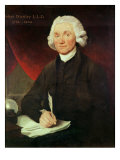
Joseph Priestley
b. 3-13-1733; Birstall, England
d. 2-8-1804; Pennsylvania
Joseph Priestley, a natural philosopher, theologian, Dissenting clergyman, political theorist, and teacher, is generally considered the discoverer of oxygen gas (Carl Wilhelm Scheele and Antoine Lavoisier are contenders).
FYI - Priestley was the great grandfather of architect H. H. Richardson, and great-great grandfather of Hilaire Belloc.
• Joseph Priestley and the Discovery of Oxygen (Grades 6-8)
• Joseph Priestley, Scientist, Philosopher, and Theologian
|
|
|
|
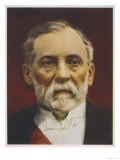
Joseph Proust
b. 9-26-1754; Angers, France
d. 7-5-1826
Joseph Proust is best known for his “Law of definite proportions,” stating, in compounds, the elements combine in proportion with each other, by mass.
Proust, with Pilâtre de Rozier, went on an early balloon flight. He was also a chemistry and physics teacher.
|
|
|
previous page | top | next
Famous Chemist & Physicists List | a | b | c | d-e | f | g | h | i-j-k | l | m | n-o | P | q-r | s | t | u-z
|
|
I have searched the web for visual, text, and manipulative curriculum support materials - teaching posters, art prints, maps, charts, calendars, books and educational toys featuring famous people, places and events - to help teachers optimize their valuable time and budget.
Browsing the subject areas at NetPosterWorks.com is a learning experience where educators can plan context rich environments while comparing prices, special discounts, framing options and shipping from educational resources.
Thank you for starting your search for inspirational, motivational, and educational posters and learning materials at NetPosterWorks.com. If you need help please contact us.
|
|
|