|
|
|
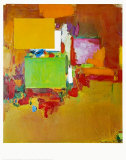
Hans Hofmann
b. 3-21-1880; Weibenburg, Bavaria, Germany
d. 2-17-1966; NYC
Hans Hofmann had a gift for science, art and teaching, but chose art as his means of expression, and teaching became his means of support before his art was recognized.
Hans Hofmann quotes ~
• “Being an artist and being a teacher are two conflicting things. When I paint, I improvise… I deny theory and method and rely only on empathy and feeling… In teaching, it is just the opposite, I must account for every line, shape and color. One is forced to explain the inexplicable.”
• “The whole world, as we experience it visually, comes to us through the mystic realm of color.”
• “Painters must speak through paint, not through words.”
• “Being inexhaustible, life and nature are a constant stimulus for a creative mind.”
• “It is not the form that dictates the color, but the color that brings out the form.”
• “Colors must fit together as pieces in a puzzle or cogs in a wheel.”
• “When the impulses which stir us to profound emotion are integrated with the medium of expression, every interview of the soul may become art. This is contingent upon mastery of the medium.”
• “To worship the product and ignore its development leads to dilettantism and reaction.”
• Hans Hofmann: Revised and Expanded
|
|
|
|
John Holt
b. 4-14-1923; NYC
d. 9-14-1985
John Holt, a proponent of homeschooling, believed that children in school were failing because of fear of getting the wrong answer. His philosopy was “... the human animal is a learning animal; we like to learn; we are good at it; we don't need to be shown how or made to do it. What kills the processes are the people interfering with it or trying to regulate it or control it.” - from a 1980 Conversation with John Holt.
John Holt quotes ~
• “What makes people smart, curious, alert, observant, competent, confident, resourceful, persistent - in the broadest and best sense, intelligent- is not having access to more and more learning places, resources, and specialists, but being able in their lives to do a wide variety of interesting things that matter, things that challenge their ingenuity, skill, and judgement, and that make an obvious difference in their lives and the lives of people around them.”
• “Living is learning and when kids are living fully and energetically and happily they are learning a lot, even if we don't always know what it is.”
• “If we continually try to force a child to do what he is afraid to do, he will become more timid, and will use his brains and energy, not to explore the unknown, but to find ways to avoid the pressures we put on him.”
• “We teachers - perhaps all human beings - are in the grip of an astonishing delusion. We think that we can take a picture, a structure, a working model of something, constructed in our minds out of long experience and familiarity, and by turning that model into a string of words, transplant it whole into the mind of someone else. Perhaps once in a thousand times, when the explanation is extraordinary good, and the listener extraordinary experienced and skillful at turning word strings into non-verbal reality, and when the explainer and listener share in common many of the experiences being talked about, the process may work, and some real meaning may be communicated. Most of the time, explaining does not increase understanding, and may even lessen it.”
• “Children do not like being incompetent anymore than the like being ignorant. They want to learn how to do, and do well, the things they see being done by bigger people around them. This is why they soon find school such a disappointment; they so seldom get a chance to learn anything important or do anything real. But many defenders of childhood, in or out of school, seem to have this vested interest in the children's incompetence, which they often call “letting the child be a child.”
|
|
|
|
Gustav Holst
b. 9-21-1874; Cheltenham, Gloucestershire, England
d. 5-25-1934; London (complications of surgery)
Gustav Holst, composer, teacher and conductor, is best remembered for The Planets.
• “Never compose anything unless the not composing of it becomes a positive nuisance to you.”
• “Music, being identical with heaven, isn't a thing of momentary thrills, or even hourly ones. It's a condition of eternity.”
• “If nobody likes your work, you have to go on just for the sake of the work. And you're in no danger of letting the public make you repeat yourself. Every artist ought to pray that he may not be "a success". If he's a failure he stands a good chance of concentrating upon the best work of which he's capable.”
• “One of the advantages of being over forty is that one begins to learn the difference between knowing and realising.”
• “The enormity of the universe revealed by science cannot readily be grasped by the human brain, but the music of The Planets enables the mind to acquire some comprehension of the vastness of space where rational understanding fails.”
• “About 'Aristocracy in art' - art is not for all but only for the chosen few - but the only way to find those few is to bring art to everyone - then the artists have a sort of masonic signal by which they recognise each other in the crowd.”
• “That the artist is born again & starts afresh with every new work.”
|
|
|
|
bell hooks
née Gloria Jean Watkins
b. 9-25-1952; Hopkinsville, KY
bell hooks, the pen name of Gloria Jan Watkins, is a feminist and social activist whose writng focuses on the interconnectivity of race, class and gender. She is a professor of English and has published numerous books of poetry and nonfiction.
belle hooks quotes ~
• “The function of art is to do more than tell it like it is-it’s to imagine what is possible.”
• “When we face pain in relationships our first response is often to sever bonds rather than to maintain commitment.”
• “Genuine love is rarely an emotional space where needs are instantly gratified. To know love we have to invest time and commitment...‘dreaming that love will save us, solve all our problems or provide a steady state of bliss or security only keeps us stuck in wishful fantasy, undermining the real power of the love -- which is to transform us.’ Many people want love to function like a drug, giving them an immediate and sustained high. They want to do nothing, just passively receive the good feeling.”
• “I will not have my life narrowed down. I will not bow down to somebody else's whim or to someone else's ignorance.”
• “Love is a combination of care, commitment, knowledge, responsibility, respect and trust.”
• “When we drop fear, we can draw nearer to people, we can draw nearer to the earth, we can draw nearer to all the heavenly creatures that surround us.”
• “I am passionate about everything in my life – first and foremost, passionate about ideas. And that's a dangerous person to be in this society, not just because I'm a woman, but because it's such a fundamentally anti-intellectual, anti-critical thinking society.”
• “Being oppressed means the absence of choices.”
• “One of the most subversive institutions in the United States is the public library...”
• “I entered the classroom with the conviction that it was crucial for me and every other student to be an active participant, not a passive consumer ... education as the practice of freedom ... education that connects the will to know with the will to become. Learning is a place where paradise can be created.”
• “No other group in America has so had their identity socialized out of existence as have black women... When black people are talked about the focus tends to be on black men; and when women are talked about the focus tends to be on white women.”
• “I thought about how we need to make children feel that there are times in their lives when they need to be alone and quiet and to be able to accept their aloneness.”
• “Life-transforming ideas have always come to me through books.”
• “Some people act as though art that is for a mass audience is not good art, and I think this has been a very negative thing. I know that I have wanted very much to write books that are accessible to the widest audience possible.”
• “Death is with you all the time; you get deeper in it as you move towards it, but it's not unfamiliar to you. It's always been there, so what becomes unfamiliar to you when you pass away from the moment is really life.”
• “I feel like there is always something trying to pull us back into sleep, that there is this sort of seductive quality in all the hedonistic pleasures that pull on us.”
|
|
|
|
Myles Horton
b. 7-2-1905; Savannah, Tennessee
d. 1-19-1990
Called the “Father of the Civil Rights Movement”, educator and socialist Myles Horton was the cofounder, with Don West and James A. Dombrowski, of the Highlander Folk School. Among his students were Dr. Martin Luther King, Jr. and Rosa Parks.
The school was created in 1932 “to provide an educational center in the South for the training of rural and industrial leaders, and for the conservation and enrichment of the indigenous cultural values of the mountains.”
The school was based on the non-academic folk high schools of Denmark for adult education on the belief that schools should educate for life, commonly called lifelong learning.
Myles Horton quotes ~
• “If people have a position on something and you try to argue them into changing it, you're going to strengthen that position. If you want to change people's ideas, you shouldn't try to convince them intellectually. What you need to do is get them into a situation where they'll have to act on ideas, not argue about them.”
• “The only accurate charge I ever had made against me was the time I got arrested [at a mine strike] in 1934. They said I was ‘getting information and going back and teaching it.’ That's exactly what I was doing.”
• “Only people with hope will struggle. The people who are hopeless are grist for the fascist mill. Because they have no hope, they have nothing to build on. If people are in trouble, if people are suffering and exploited and want to get out from under the heel of oppression, if they have hope that it can be done, if they can see a path that leads to a solution, a path that makes sense to them and is consistent with their beliefs and their experience, then they'll move. But it must be a path that they've started clearing. They've got to know the direction in which they are going and have a general idea of the kind of society they'd like to have. If they don't have hope, they don't even look for a path. They look for somebody else to do it for them.”
• peace education posters
|
|
|
|
|
|